| Home
|
GEPRODIS
W. J. Sidis
1929 - 1930
[Mimeographed
pamphlet, 42 p, presumedly unpublished, found
in Helena Sidis's files, 1977.] |
 "... a
new type of organization ... "... a
new type of organization ...
a non-profit membership corporation ...
a federation of
its employees."
TABLE OF CONTENTS
(Click/tap
chapter
numbers to open.)
|
I |
The Geprodis Association
|
|
II
|
What the Plan Is Not |
|
III
|
General Outline of the Plan |
|
IV
|
Draft of Constitution for Geprodis |
|
V |
Code of Group Procedure
|
|
VI
|
Model Constitution |
|
VII
|
Geprodis
Organisation News
|
|
VIII
|
Proposal for Manuscript Library
|
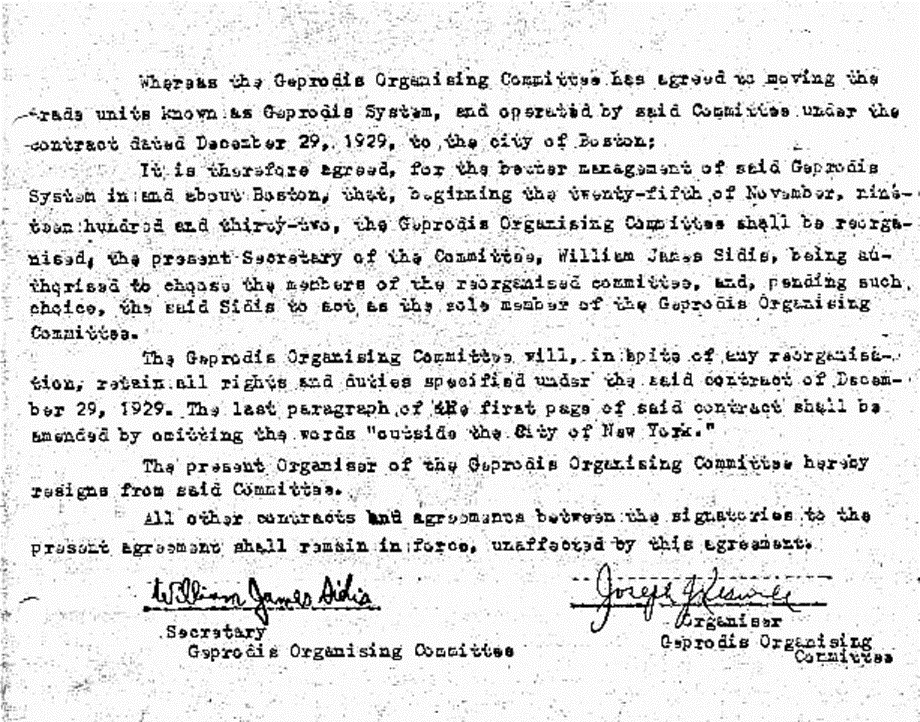
Whereas the Geprodis Organising
Committee has agreed to moving the trade units known as Geprodis System, and
operated by said Committee under the contract dated
[Sunday,] December 29, 1929, to the city of Boston;
It is therefore agreed, for the better
management of said Geprodis System in and about Boston, that, beginning
[Friday,] the twenty-fifth of November,
nineteen hundred and thirty-two, the Geprodis Organising Committee shall
be reorganised, the present Secretary of the Committee, William James
Sidis, being authorised to choose the members of the reorganised
committee, and, pending such choice, the said Sidis to act as the sole
member of the Geprodis Organising Committee.
The Geprodis Organising Committee will,
in spite of any reorganisation, retain all rights and duties specified
under the said contract of December 29, 1929. The last paragraph of the
first page of said contract shall be amended by omitting the words
"outside the City of New York."
The present Organiser of the Geprodis Organising Committee hereby resigns
from said Committee.
All other contracts and
agreements between the signatories to the present agreement shall remain
in force, unaffected by this agreement.
|
William James Sidis,
Secretary
Geprodis
Organising Committee
|
Joseph J. Resnick
Organiser
Geprodis
Organising Committee |
Anonymous email from a reader:
|
Below
is the result of your feedback form. It was submitted by () on Friday,
April 14, 2006 at 23:34:29
---------------------------------------
Liberty
is the essential public-trust. Justice is the essential public
responsibility. Liberty is self-governance self arrest of harm. Justice
is arresting harm when threatened and restoring persons to whole when harm
has already occurred. Congruence requires that Liberty and Justice be
universal. Rights are the boundaries of behavior by which Liberty and
Justice are measured and realized. Rights are enumerated proscriptions of
behavior which are valid when derivable from the Liberty Principle the
supreme moral law. This and only this is the moral basis for establishment
of a moral society and the governmental institutions within a moral
society. The motto of a moral society is Liberty and Justice for All.
Orarchy
was coined by Sidis to mean a government founded on the Liberty principle.
Unfortunately Sidis thought experiment on drafting a Constitution was a
synthesis of socialism and libertarianism. As brilliant as he was, this
was written before WWI, before the reality of the flaws in socialism had
been made manifest, before economic science discovered that the fatal flaw
in command economies is information deprivation as well as being a
violation of moral law.
Democracy is inherently flawed as a moral principle or as a basis on which
to establish government. When you must decide, and you know you don t
know, it is philosophy which determines your decision. Democracy is a
tool for decision making under conditions of uncertainty but it is by
nature ungoverned by a rational moral philosophy. The wishful thinking by
those who have faith in democracy, is that the demos IS governed by a
rational moral philosophy. History and an understanding of the current
demos shows that we have not yet enculturated a rational moral philosophy.
Thus at best, if a democratic method is to be employed, it should be
strictly limited to decision making on issues of short term consequence.
The
best system for making collective decisions is a coercion free market. To
the extent fraud can also be arrested in a market it is bettered.
|
|
Reply:--
The
second paragraph is the only problem here. Sidis's constitutions
were written well after he had abandoned any interest in Soviet socialism
(see, e.g.,
Eichel's Bio ,
Social Continuity). Also, the word "orarchy"
was not coined by Sidis. It can be found in some 19th Century dictionaries
and means "limited government."
I wish
the writer would send me his name so that I might read more written by
him. His thoughts are brilliant and I think Sidis would agree with much of
what he says. ―Dan
Mahony
|
|