"The lust for fame is the last infirmity
cast off
even by the wise."—Tacitus
|
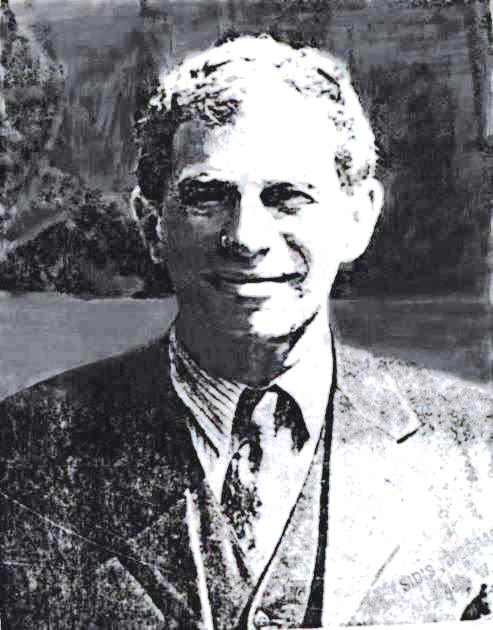
"His numerous friends do not like the false newspaper picture of
him, as a pauper and anti-social recluse. ... Bill Sidis was a quiet man who
enjoyed the normal things of life. His friends respected him and enjoyed his
company. I am glad to have been one of his friends."—Shirley
S. Smith, Wellesley Hills
|
|
And all the while, he adhered to the Okamakammesset principle of
anonymous contribution.—Dan Mahony
|
W. J. Sidis, 1898 - 1944
+
|
|
(Click/tap to open, enlarge.)
*
|
BEYONDREPROACH
DECLARATIONS OF ITS
JOURNALISTIC STANDARDS
|

"For more than a
century, men and women of The Times have jealously guarded the paper’s
integrity. ... it is imperative that The Times and its staff maintain the
highest possible standards to insure that we do nothing that might erode
readers’ faith and confidence in our news columns. This means that the
journalism we practice daily must be beyond reproach."
http://www.nytco.com/who-we-are/culture/standards-and-ethics/
"It is our policy to
correct our errors, large and small, as soon as we become aware of them.
... If a reader asks for a correction, that request should be passed
promptly to a supervisor."
http://www.nytco.com/wp-content/uploads/NYT_Ethical_Journalism_0904-1.pdf
|
Compiled by Dan Mahony
" ... or something worse ... "

(Click / tap images to open, again to enlarge.)
|
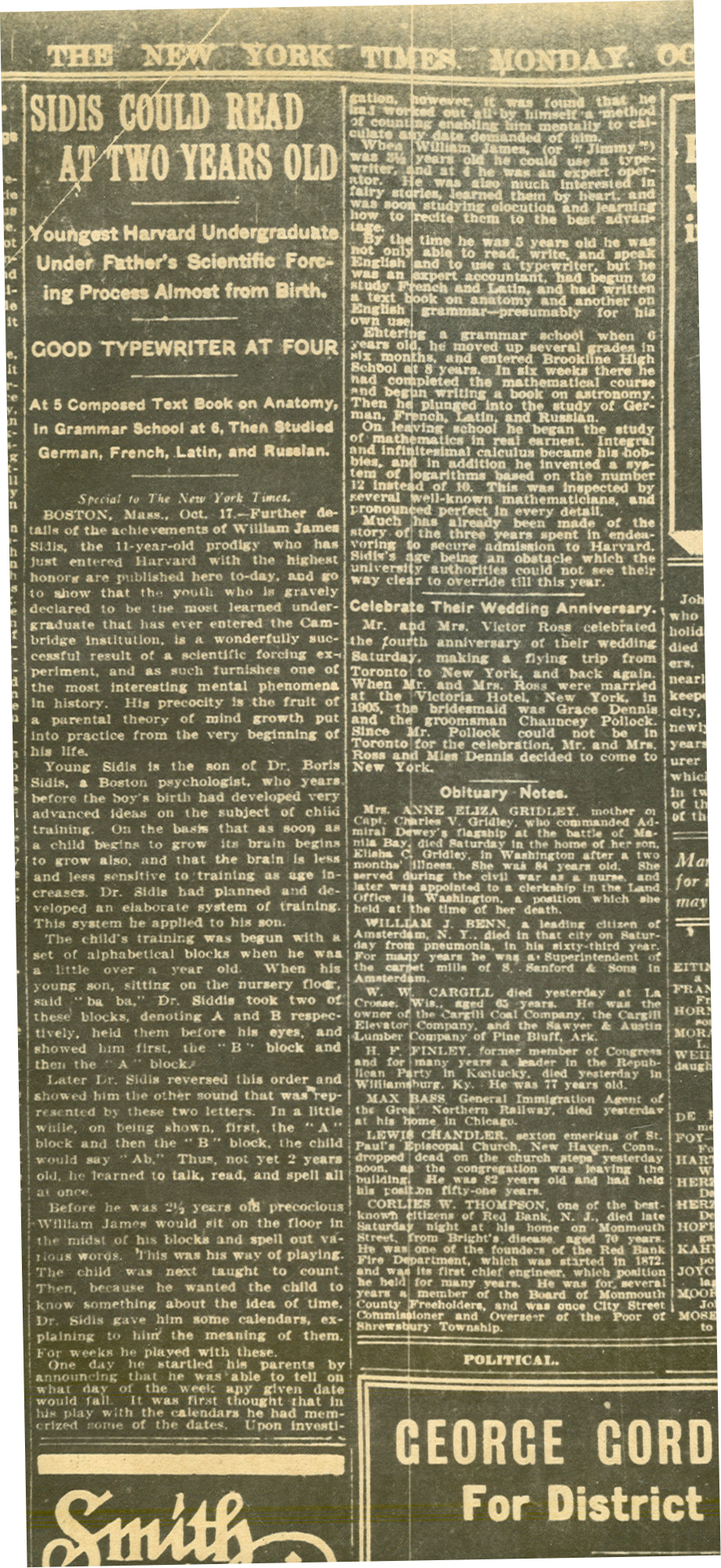
SIDIS COULD READ AT TWO YEARS OLD
Youngest Harvard Undergraduate
Under
Father's Scientific Forcing Process Almost from Birth
GOOD TYPEWRITER AT FOUR
At 5 Composed Textbook on
Anatomy, in Grammar School at 6, Then Studied German, French,
Latin, and Russian
Special to The New York Times.
Mon., Oct. 18, 1909
ARTICLE ALLEDGES "SCIENTIFIC FORCING
EXPERIMENT"
DOESN'T CITE ANY SOURCE.
 1.
NOT TRUE! 1.
NOT TRUE!
------------
His mother Sarah re his early education:
|
"He asked me a question one day, and then
triumphantly said, 'But you will say, "Let's look it up!" and I can
look it up myself!' That is the last lesson I gave Billy."—Sidis
Story, Chap. 5. |
------------
Boris Sidis's early education
of his son::
"With the aid
of a box of alphabet blocks, [his father Dr. Sidis] actually
succeeded in teaching him how to spell and read before he was
three. He did this by playing with the boy, shifting the
alphabet blocks around to spell different words, pointing to the
objects spelt, and naming them aloud. The effect of this was not
simply to teach the child spelling and reading, but also to give
him a thorough grounding in the principles of sound reasoning.
"Moreover, the method employed by Dr. Sidis seemed to impart to
his son a power of mental concentration seldom seen in
children. ... Once his attention was arrested, his interest
aroused, he was not content until he had learned the exact
nature of whatever had excited his curiosity.Cont. →
|
|
|
"The child is essentially a
thinking animal. No power on earth can keep him from thinking,
from using his mind. From the moment his inquiring eyes first take
in the details of his surroundings he begins the mental processes
which education is intended to guide and develop. He observes, he
draws inferences from everything he sees and hears, he seeks to
give expression to his thoughts.
“Left to himself, however, he is certain to observe inaccurately
and to make many erroneous inferences. Unless he is taught how to
think he is sure to think incorrectly, and to acquire wrong
thought habits, causing him to form bad judgments respecting
matters not only vital to his own welfare but also important to
the welfare of society. In fact, in order to get the best results,
his training in the principles of correct thinking should begin as
soon as, or even before, he starts to talk. There need be no fear
of over-taxing his mind. On the contrary, the effect will be to
develop and strengthen it, by accustoming him to make habitual use
of the latent energy which most people never utilize at all.”—Boris
Sidis In
Bending the
Twig
by Harold Addington Bruce, writer and family friend who witnessed
the above. |
| "You must begin a child's
education as soon as he displays any power to think. Everybody
knows how hard it is to learn a new language late in life. The
same holds good of all our acquisitions. The earlier they are
acquired the more truly they become part of us."—Boris
Sidis in Current Literature, 1910 |
2.
The New York Times
reports his age incorrectly on the front page, and
3.
in its Sunday magazine.
HARVARD'S CHILD PRODIGY
All Amazed at
Mathematical Grasp of Youngest Matriculate, Aged 13 Years

Mon., Oct. 11, 1909
HE WAS
ELEVEN NOT THIRTEEN
His age was the was the
most important news detail.
SAYS HE WENT TO TUFTS THE PREVIOUS YEAR.
4.
NOT TRUE.
SAYS
SIDIS WAS CHUMS WITH NORBERT WIENER THERE.
5.
COMPLETE
FANTASY.
SAYS
HE IS OF
POLISH DESCENT.
6.
NOT
TRUE. BOTH PARENTS FROM RUSSIA (UKRAINE).
|
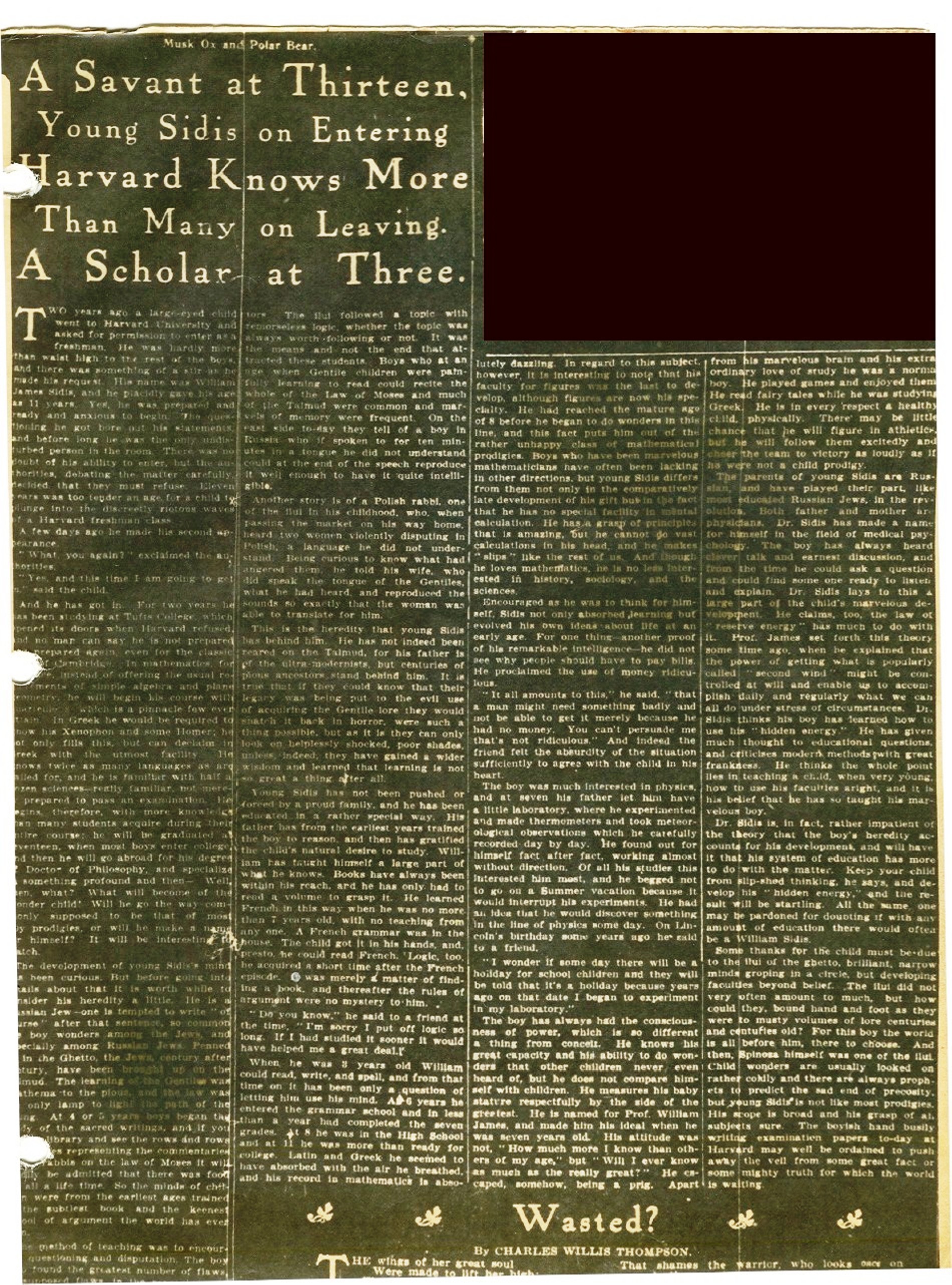
A Savant at Thirteen, Young Sidis Knows More on Entering Than Many on
Leaving.
A Scholar at Three
 
Sun., Oct. 17, 1909
7.
AGE WRONG FOR FOURTH TIME
"For two years he has been studying at Tufts
College."
8.
NOT TRUE.
NEVER WENT THERE. Completely invented, either by
the editorial staff, or their unattributed source.
9.
Burnout
'...usual
fate of child wonders ..."
says TNYT AS IT ASSERTS BURNOUT MYTH #1 IS
TRUE OF SIDIS
*
FAILURE MYTH REFUTED BY PHILOSOPHER CHARLES SANDERS PEIRCE
|
The idea that
precocity―or at any rate precocity of any such character as this― generally
dies down into mediocrity has very little foundation. Some actually go so
far as to think that the very fact of unusual brilliancy in a child at so
early an age is a prophesy of little ability when he grows up; a notion that
rests upon the same fallacy as that which regards the children of highly
gifted parents as less likely to be highly endowed than other children. They
are vastly more likely to be thus endowed― as Galton conclusively
demonstrated in his "Hereditary Genius."―C.
S. Peirce, The Nation,
1910 |
|
BOY OF TEN ADDRESSES HARVARD TEACHERS
Young Sidis Kidnaps the Fourth
Dimension and "Revolutionizes Geometry"
PROPOUNDS NEW THEORIES
After the
Lecture the Learned Professors Crowd Round the Lad for Further Elucidation

Thursday, Jan. 6, 1910
10.
AGE WRONG FOR FIFTH TIME
NOW TNYT SAYS HE'S
TEN
|
TOPICS OF THE TIMES
Illustrating a System of Education
Fri., Jan 7, 1910
|
"The
usual fate of child wonders is that they fall into mediocrity or
something worse as soon as their years catch up with their precocious
achievements." —assures The New York Times. |
11.
AGE WRONG FOR SIXTH TIME, ALONG WITH
12.
BURNOUT MYTH #1
|
Wonderful Boys of History Compared with Sidis:
All Except Mcauley
Showed Special Ability in Mathematics---Instances of Boys Having
"Universal Genius"
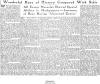
Sun., Jan. 16, 1910
WORTH READING. TALKS ABOUT PRODIGIES WHO WERE
SUCCESSFUL AS ADULTS. |
|
13.
AGE WRONG FOR SEVENTH TIME
HARVARD'S CHILD QUARTET
Sidis, Aged 13, Has Three Rivals 15 Years Old and Younger—One
A Girl

Mon., Jan. 10, 1910
*
PHILOSOPHER CHARLES SANDERS PEIRCE RE BORIS'S ROLE IN SON'S GENIUS
|
Another question
raised in connection with young Sidis is that of training versus
native endowment. Dr. Boris Sidis, the eminent psychologist who is
the boy's father, is said to regard his son's achievements as
indicating that by proper methods of instruction several years
could be cut off from the time actually employed in bringing boys
up to the college or university stage. With the proposition itself
we have no particular fault to find; but that young Sidis's
exploits serve in any degree to establish it we deny without
hesitation. The part played by native genius is so manifestly
predominant in this case as to nullify any general application.
This is evident on the face of the matter; but confirmation of the
strongest kind is given, if any were needed, in such precedents as
those of Pascal or Hamilton, both of whom made the amazing
mathematical conquests of their youth without any outside help
whatsoever.―C. S. Peirce, The Nation, 1910 |
|
DR. SIDIS TO CURE HOBBIES
Receives Gift of Estate for Sanitarium
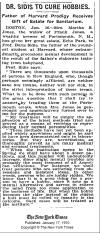
Mon., Jan. 17, 1910
"CURE HOBBIES"
14.
DISPARAGES
BORIS SIDIS
Here's
what he actually said:
|
"We know that it is a good thing for a
person to have a hobby, since it acts as a mental alternative and serves
to relieve the mind from too close application to the business of life.
But when the hobby becomes the rider instead of the ridden a halt must
be called or insanity is the outcome. Such cases will be treated at the
institute." |
|
SIDIS, BOY PRODIGY, ILL
Attacked With Grip After His Lecture on "The
Fourth Dimension"
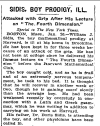
Thurs., Jan. 27, 1910
The paper says:
"Boy is frail and of an extremely nervous temperament ... he has been
weakened recently by overstudy ..."
15.
NOT TRUE.
HE'S HEALTHY AND STRONG.
|
"His cheeks have a
ruddy glow, his eyes sparkle, he has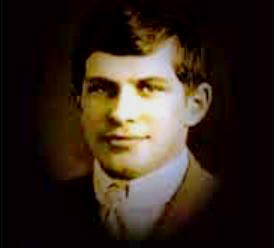 a ringing laugh, and is
fairly bubbling over with animal spirits."-—H.
A. Bruce, In
Bending the Twig a ringing laugh, and is
fairly bubbling over with animal spirits."-—H.
A. Bruce, In
Bending the Twig |
THE GRIPPE IS THE FLU.
|
" ... broken down from overwork."
16.
.NOT TRUE!
" ... sure to excite a chorus of, "I told you so!"
17. Failure
Myth
Young Sidis Suffers a Breakdown
Thurs.,
Jan. 27, 1910
Article then says he suffers from
"psychasthenia"
(a psychological disorder characterized by phobias, obsessions,
compulsions, or excessive anxiety) which, it says, is caused by
his inability to manage his new-found fame. No
source of diagnosis is cited.
18.
NOT TRUE.
19.
Unethical to publish a psychiatric diagnosis attributed TO an
identified MINOR
POSSIBLY UNLAWFUL.
|
This little one, based entirely on rumor, packs a big punch in the damage
it might have done to young
Sidis's reputation.
FEAR IS FELT FOR SIDIS
Harvard's Boy Scientist May
Never Resume his University Work
Special to The New York Times
Fri., Jan. 28, 1910
20..
ITEM 'S MAIN TOPIC
IS BASED SOLELY ON RUMOR:
"There are rumors in Cambridge that he will never return to
his studies."
21.Then
iit quotes but does not identify friends of the family:
"Too great mental exertion has had a great deal to do with the boy's
sudden collapse."
Thus again is transmitted the burn-out myth three: all work
and no play..
*
|
"William James Sidis was a genius. He
was by far the most precocious intellectual child of his
generation. His death in 1944 as an undistinguished
figure was made the occasion for reawakening the old
wives tales about nervous breakdowns, burned out
prodigies and insanity among geniuses."—-Dr.
Abraham Sperling in Psychology for the Millions |
*
FLU'S GRIP LOOSENS AND HE'S RIGHT BACK AT SCHOOL.
HE PROBABLY TOOK MID-YEAR EXAMS LATE.. HIS
TRANSCRIPT
SHOWS NO INTERRUPTION OF HIS STUDIES.
MID-YEAR EXAMS BEGAN THURSDAY, JAN.
27. SAME DAY TNYT PUBLISHED ARTICLE SAYING HE HAD FLU:
Harvard
Calendar,
1910.
|
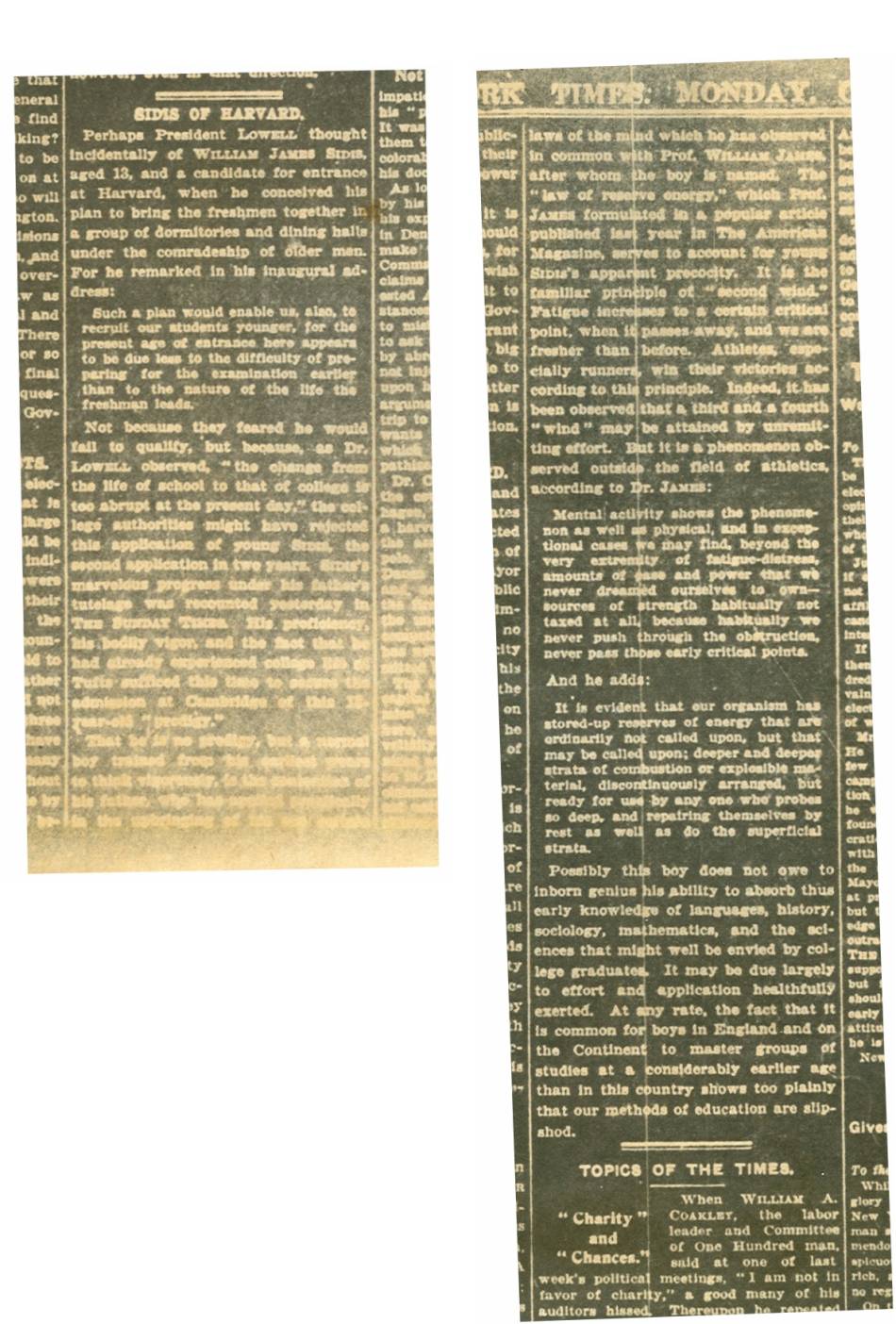
SIDIS OF HARVARD

Mon., Oct. 18, 1909
22.
Age wrong again.
Says he's 13.
23.
Says he went to Tufts.
Not true.
|
 HARVARD
A. B. AT 16 HARVARD
A. B. AT 16
William James Sidis the Youngest Student to Get That Degree
There

Sun., June 14, 1914, p. 1.
A HUGE SUCCESS BUT THE TIMES
CAN SPARE ONLY TWO COLUMN INCHES
BUT STILL IT'S ENOUGH SPACE FOR THREE
MORE FACTUAL ERRORS:
"He completed his full course of study last year but was declared too
young to graduate."
24.
NOT TRUE! HIS
TRANSCRIPT
SHOWS A FULL COURSE OF STUDY IN HIS FINAL YEAR.
Youngest Student to Get That Degree There
25.
NOT TRUE. COTTON MATHER WAS.
SIDIS WAS YOUNGEST ENTRANT, NOT
YOUNGEST GRADUATE
TIMES MANAGES TO GET MATHER'S AGE WRONG
TOO! "GRADUATED FROM HARVARD AT THE AGE OF 13 ACCORDING TO MUSTY RECORDS"

MATHER ENTERED AT 12, GRADUATED AT 15—wiki
|
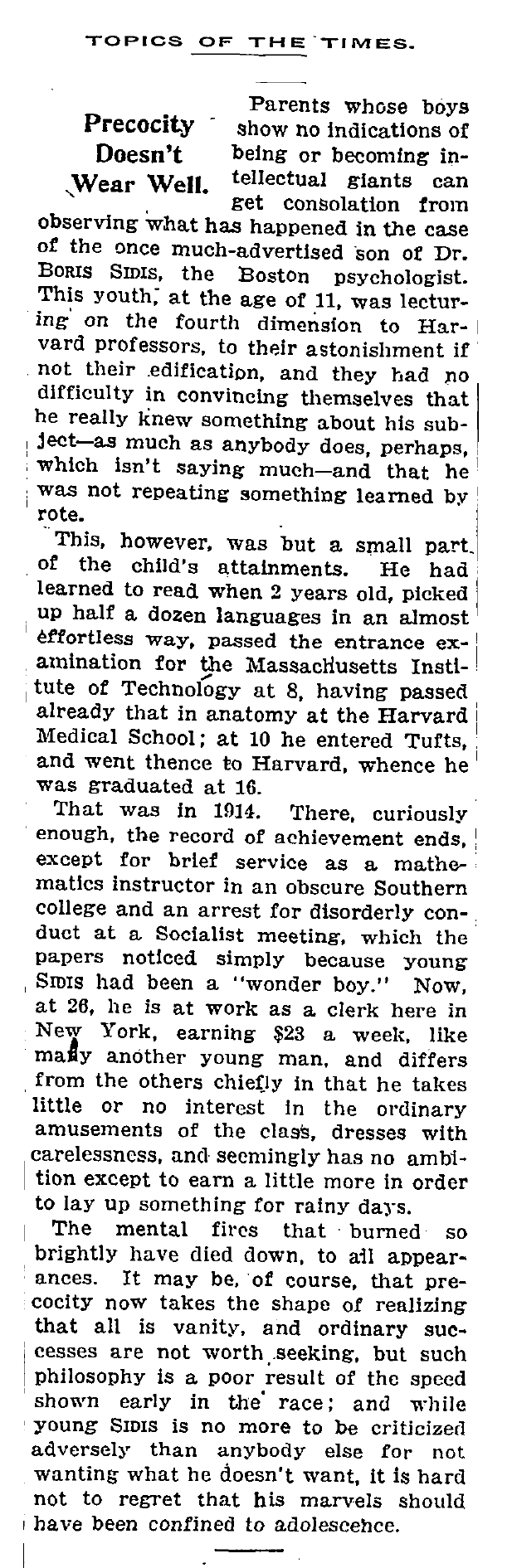
TOPICS OF THE TIMES
PRECOCITY DOESN'T WEAR WELL

Fri., Jan 11, 1924
*
26.
A general summary of the failure myths.
|
384.jpg)

|
DURING THIS
TIME HE COMPLETED HIS STUNNING ACHIEVEMENT IN COSMOLOGY,
The Animate and the Inanimate.
IN WHICH HE DISCOVERED THE OTHER HALF OF THE UNIVERSE
Not knowing about this book,
TNYT wrote:
"The mental fires that burned early have
died down."
"The record of achievement ends."
"Disorderly conduct at a socialist meeting."
"At work as a clerk."
"Dresses carelessly."
"Hard not to regret his marvels should have been confined to
his adolescence."
|
|
SIDIS, A "WONDER" IN BOYHOOD, DIES
Graduate of Harvard
at 16.
He Later Sought Jobs Requiring Little Training
RAN ADDING
MACHINE HERE
Retiring to Boston He Taught in School Some
Called "Bolshevistic"

Tues., July 18, 1944 |
IN A REPORT OF A MAN'S DEATH THE
NEW YORK TIMES DISPARAGES HIM! " ... apparently destitute."
27.
NOT SO! HIS RENT MUST HAVE BEEN UP TO DATE OR HE WOULDN'T BE LIVING THERE.
AT THE TIME OF HIS DEATH SIDIS HAD TODAY'S
EQUIVALENT OF $2500 IN SAVINGS.. SEE
BANK LETTER.
"Bill Sidis paid his way; he was no burden on society."
Shirley Smith (personal friend)
DURING
A LIFE OF FULL TIME JOBS SIDIS PRODUCED DOZENS OF BOOKS AND OTHER WRITINGSSAYS
"Taught in School Some Called
"Bolshevistic"
28.
NOT SO! " We were
both libertarians ...
Sidis had a strong love for America and its traditions of
freedom."
(From
Bio by friend Julius Eichel.)
29.
SAYS FOR FOURTH TIME HE WENT TO TUFTS.
NOT TRUE.
30..WRONG
AGE FOR NINTH TIME.
SAYS HE WAS FOURTEEN
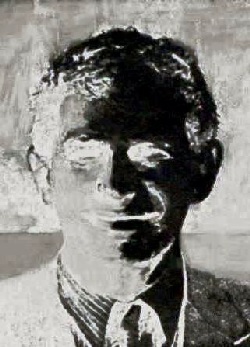
WHEN HE SPOKE AT A HARVARD MATH CLUB. HE WAS
ELEVEN. |
|
|
THE NEW YORK TIMES SHOULD CORRECT ALL OF THE ABOVE ERRORS ON THE
SAME PAGES THEY ORIGINALLY APPEARED.
*
THE NEW YORK TIMES SHOULD PUBLISH SEVEN
WORKS BY W. J. SIDIS IN PAPERBACK AND IN ALL eBOOK, AUDIO AND VIDEO
FORMATS WORLDWIDE. ROYALTIES FROM THE SEVEN WORKS SHOULD BE USED TO
PROVIDE NECESSARY EQUIPMENT, MATERIALS AND RELATED COSTS TO PERSONS WHO
REMAIN IN UNRELATED FULL-TIME EMPLOYMENT WHILE PRODUCING LEGITIMATE
WORKS IN ARTS AND SCIENCE ON THEIR OWN TIME.
*
THE NEW YORK TIMES SHOULD FUND SUBSTANTIAL BORIS SIDIS SCHOLARSHIPS IN
PSYCHOLOGY AND PSYCHIATRY AT HARVARD UNIVERSITY.
*
THE NEW YORK TIMES SHOULD
FUND ALL WEB HOSTING AND MAINTENANCE COSTS OF SIDIS.NET FOR 30 YEARS
DURING WHICH NOT A SINGLE WORD OR PUNCTUATION MARK MAY BE CHANGED
|
|

Boris Sidis, Ph. D., M.D.
|
After years of untrue and unkind journalism regarding himself and his
son, this great American psychologist and psychiatrist was deleted from the
history books of American psychology.
But now his works get more than a
thousand page-views per month here, and The Psychology of Suggestion pdf here
has lately averaged more than 5000 page-views per month. (See the
Boris Sidis Archive,
especially the clickable bibliography.)
FORTY-FIVE ITEMS IN THE NEW YORK TIMES
1904 - 1944 re BORIS SIDIS, W. J. SIDIS
|
(Click / tap images to open, enlarge.)
|
[Notice of
publication of
Multiple Personality]
Sat., March 26, 1904 |
TWO MEN IN ONE
Dr. Sidis Considers the Strange
Case of T. C. Hannah as an Instance of Multiple Personality
Sat., December 3, 1904 |
[Badger Takes Over Publication of The
Journal of Abnormal Psychology]

Sat., Feb.9, 1907 |
IN BOSTON "TECH" AT TEN
Willie Sidis Passes Examinations—Average
Age of Freshmen 21
Mon., Sept. 28, 1908 |
A STUDY OF SLEEP

Sat., May 1, 1909
|
HARVARD'S CHILD PRODIGY
All Amazed at Mathematical Grasp of
Youngest Matriculate, Aged 13 Years
Mon., Oct. 11, 1909
*
A Savant at Thirteen, Young Sidis Knows More on Entering Than Many on
Leaving.
A Scholar at Three
Sun., Oct. 17, 1909 |
SIDIS COULD READ AT TWO YEARS OLD
Youngest Harvard Undergraduate Under
Father's Scientific Forcing Process Almost from Birth
GOOD TYPEWRITER AT FOUR
At 5 Composed Textbook on Anatomy, in
Grammar School at 6, Then Studied German, French, Latin, and Russian
Mon., Oct. 18, 1909 |
SIDIS OF HARVARD
Mon., Oct. 18, 1909 |
BOY OF TEN ADDRESSES HARVARD TEACHERS
Young Sidis Kidnaps
the Fourth Dimension and "Revolutionizes Geometry"
PROPOUNDS NEW
THEORIES
After the Lecture the Learned Professors Crowd Round the Lad
for Further Elucidation
Thursday, Jan. 6, 1910 |
TOPICS OF THE TIMES
Illustrating a System of Education
Fri., Jan 7, 1910 |
YOUNG SIDIS'S TRAINING
Demonstration of It Ought to Revolutionize
Our Teaching Methods
(To the Editor)
Sun., Jan. 9, 1910 |
HARVARD'S CHILD QUARTET
Sidis, Aged 13, Has Three Rivals 15 Years Old and
Younger—One
A Girl
Mon., Jan. 10, 1910 |
The Golden Age of Youth
(To the
Editor)
Tue., Jan. 11, 1910
*
SIDIS AN AVATAR?
(To the Editor)

Wed., Jan. 12, 1910 |
HARVARD'S QUARTET OF MENTAL PRODIGIES
Unique Problem for
Psychologists in Education of Young Sidis and His Three Contemporaries
Sun., Jan., 16, 1910 |
Wonderful Boys of History Compared with Sidis:
All Except Mcauley
Showed Special Ability in Mathematics---Instances of Boys Having
"Universal Genius"
Sun., Jan. 16, 1910 |
DR. SIDIS TO CURE HOBBIES
Receives Gift of Estate for Sanitarium
Mon., Jan. 17, 1910 |
REINCARNATION
Mon., Jan.,17, 1910 |
THE FOURTH DIMENSION
It Is a Mathematical Pretension and Quite Profitless
Letter to the Editor

Sun., Jan. 23, 1910 |
SIDIS, BOY PRODIGY, ILL
Attacked With Grip After His Lecture on "The
Fourth Dimension"
Thurs., Jan. 27, 1910 |
Young Sidis Suffers a Breakdown"
Thurs., Jan. 27, 1910 |
FEAR IS FELT FOR SIDIS
Harvard's Boy Scientist
May Never Resume his University Work
Fri., Jan. 28, 1910 |
FARMER A RIVAL TO HARVARD PRODIGY
Lightning Calculator Demonstrates His
Powers to forty University Professors
WORKS INTRICATE PROBLEMS
Multiplication of Figures of Four Digits Each, Cubes of Three Figures,
Cube Roots in a Flash
Sat., Feb. 19, 1910 |
TOPICS OF THE WEEK
WILLIAM JAMES SIDIS

Sat., March 5, 1910
*
PROFESSOR LOWELL AND MASTER SIDIS
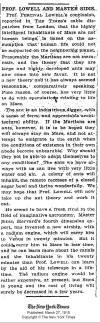
Sun., March 27, 1910 |
SEE EUCLID IN SIDIS
Theosophists Believe Harvard Prodigy is the Mathematician Reborn
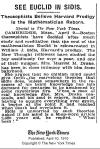
Sun., April 10, 1910 |
"PHILISTINE AND GENIUS"
Sun., June 25, 1911
*
DR. SIDIS IN AN UNKIND MOOD
His Vigorous
and Bitter Indictment of the American System of Popular Education

Sun., June 25, 1911
|
THE DORMANT WAKER
Case of Harvard Professor Who Needs No Sleep Explained

Tues., Feb. 18, 1913 |
WHAT IS LAUGHTER?
Dr. Boris Sidis Makes a Serious
Study of a Humorous Thing
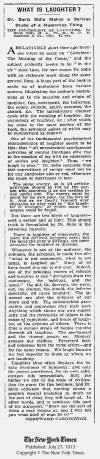
Sun., July 27, 1913 |
HARVARD
A. B. AT 16
William James Sidis the Youngest Student to Get That Degree
There
Sun., June 14, 1914, p1. |
HOW TO MAKE GENIUSES OF CHILDREN
H. Addington
Bruce Gives the Results of "Intensive Child Culture" as Shown in Such
Cases as the Son of Dr. Boris Sidis—New
Theories of Education
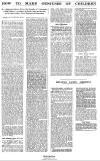
Sun., July 25, 1915 |
A NOVEL MYSTERY
Exciting and Well-Knit Crook Play Based on Abnormal Psychology
JANE
GREY SCORES HEAVILY
Cast and Production of Unusual Quality

Wed., Sept. 5, 1917 |
FOUR BOSTON RADICALS GET PRISON SENTENCES
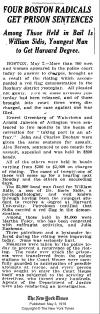
Sat., May 3, 1919
*
Young Sidis, 'Harvard Prodigy,' Sentenced to a Year and
a Half in Jail for Rioting
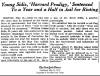
Wed., May 14, 1919
|
When Infant Prodigies Grow Up
Some of Them Who Did Are Confucius,
Caesar, Milton, Galileo, Beethoven and Voltaire


Sun., July 15, 1923
*
DR. BORIS SIDIS DIES
Internationally Known Expert in Psychology Was
56 Years Old

Thu., Oct. 25, 1923 |
TOPICS OF THE TIMES
PRECOCITY DOESN'T WEAR WELL
Fri., Jan 11, 1924
*
YOUTHFUL PRODIGIES AT GENIUS MEETING
Transfer Collector Speaks
Sun., June 20, 1926, p8. |
SUPREME COURT REJECTS SIDIS SUIT


Tues., Dec. 17, 1940
*
NO PRIVACY FOR PRODIGY
High Court Refuses to Grant Seclusion Thirty
Years After

Tues., Dec. 17, 1940 |
SIDIS, A "WONDER" IN BOYHOOD, DIES
Graduate of Harvard at 16.
He Later Sought Jobs Requiring Little Training
RAN ADDING MACHINE HERE
Retiring to Boston He Taught in School Some
Called "Bolshevistic"
Tues., July 18, 1944 |
THE HIDDEN GENIUS


Wed., July 19, 1944 |
First Myth:
Young Sidis Suffers a Breakdown
... sure to
excite a chorus of, "I told you so!"
declares
The New York Times.
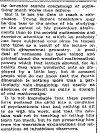
Thurs., Jan. 27, 1910
"The usual fate of child
wonders is that they fall
into mediocrity or
something worse as soon
as their years catch up
with their precocious
achievements,"
we are assured.
TOPICS OF THE TIMES
Illustrating a System of Education
Fri., Jan 7, 1910
Just why so many believed the fallacy that
child prodigies tend toward nervous breakdowns
and unproductive lives is hard to know. There has
never been any actual evidence for it.
(See Dr. Sperling's short
bio of Sidis; research by
Dr. Lewis Terman.)
===================================
 Second Myth:
it was supposed that his father,
Second Myth:
it was supposed that his father,
Boris Sidis, a great
psychologist, somehow caused his
son's genius.
Youngest Harvard
Undergraduate Under Father's Scientific
Forcing Process Almost from Birth
Times declares..
Mon., Oct. 18, 1909
His mother Sarah re his education:
|
"He asked me a question one day, and
then triumphantly said, 'But you will say, "Let's look it up!" and I
can look it up myself!' That is the last lesson I gave Billy."—Sidis
Story, Chap. 5. |
His father's methods:
|
To realize his
great aim of energizing and rationalizing the child, his father
Boris began to train him in the use of his observational and
reasoning faculties before he was two years old, and, with the aid
of a box of alphabet blocks, actually succeeded in teaching him how
to spell and read before he was three. He did this by playing with
the boy, shifting the alphabet blocks around to spell different
words, pointing to the objects spelt, and naming them aloud. The
effect of this was not simply to teach the child spelling and
reading, but also to give him a thorough grounding in the principles
of sound reasoning.
Moreover, the method employed by Dr.
Sidis seemed to impart to his son a power of mental concentration
seldom seen in children. ...
Once his attention was arrested, his interest
aroused, he was not content until he had learned the exact nature of
whatever had excited his curiosity.—In
Bending the Twig by
Harold Addington Bruce,
writer and family friend who witnessed the above. |
===================================
Third Myth:
too much mental exertion caused
his supposed failure.
This little one packs a big punch in the
damage done to
young Sidis's reputation under the guise
of empathy.
FEAR IS FELT FOR SIDIS
Harvard's Boy Scientist May Never
Resume his University Work --Times.
Fri., Jan. 28, 1910
THE SOLE SOURCE FOR THIS ITEM
IS RUMOR:
"There are rumors in Cambridge that he will
never return to his studies."
Then it quotes but does not identify friends of the family:
"Too great mental exertion has had a great deal
to do with
the boy's sudden collapse."
HE WAS SOON BACK AT SCHOOL.
HIS
TRANSCRIPT SHOWS NO INTERRUPTION OF
HIS STUDIES.

PERHAPS THE ARTICLE OF JAN. 28 WAS PROMPTED BY
HIS
ABSENCE THE DAY BEFORE WHEN THE MID-YEAR EXAMS
BEGAN. ONCE RECOVERED, HE PROBABLY TOOK THE
EXAMS LATE.

===================================
Fourth Myth:
his not working at high-paying
jobs was confirmation of failure.
He paid his way and funded his own research.
Tues., July 18, 1944
He Later Sought Jobs Requiring Little Training
RAN ADDING MACHINE
HERE --Times.
|
People's Editor:
This is about
Bill Sidis, who died Monday. His numerous friends do not like the
false newspaper picture of him as a pauper and anti-social
recluse. Bill Sidis held a clerical position until two weeks ago.
For two weeks he had received unemployment compensation. the first
time in his life. Today he was to start on a new job for which he
had already been hired. Bill Sidis paid his way; he was no burden
on society.—Shirley
S. Smith, Wellesley Hills
|
|

Comptometer
(Click/tap to enlarge, and again.)
"The "adding
machines" that the newspapers described him to be working in later
life were comptometers. Moreover, he would work two of them at a
time, one with his left hand and one with his right, using his
elbows for the space bar. That's not all. Supplied with a full share
work that was supposed to consume an eight hour day, he would finish
all of it within one hour."--Dr.
Abraham Sperling
|
===================================
Fifth Myth, that
his political beliefs
were evidence of
failure because he was supposedly
a "Bolshevist."
lign="justify">
At the center of his philosophy of life were
(1) the principle of anonymous
contribution
(2) the supremacy of individual
rights. (See
Continuity News menu. See
America's Search
for Liberty in Song and
Poem.) Wrote Sidis:
"Unfortunately, too many Americans consider
the search for liberty as at an end, as if it had
been secured and made safe for all time by the
founding fathers. To the contrary, the struggle
for liberty is one requiring eternal vigilance."
===================================
Myth Six: Inability to Manage Fame.
Article says he suffers
from
"psychasthenia"
(a psychiatric disorder characterized by phobias,
obsessions, compulsions, or excessive anxiety)
which,
The NYTimes
says is
" ... caused by his inability to
manage the morbid excitements and excessive attention
to which he probably has been subjected ever since he
leaped into fame..."
No source of diagnosis
is cited.
Attribution of a psychiatric diagnosis to an
identified
minor is certainly unethical, perhaps even
unlawful.
Thurs., Jan. 27, 1910
===================================
Myth Seven, that
his brain hemorrhage
was caused by too much
thinking
rests on a confusion
of mind and brain.
Heredity may have played a role. His father died of
the same infirmity.
==================================================
It is not
difficult to refute the failure myths.
That prodigies "burn-out" has
been disproved by
abundant historical and
statistical evidence. The
well-known research by
Lewis Terman shows
that the
vast majority of prodigies go on to lead
productive lives. As did
Sidis.
The second misconception is
contradicted by the
practical fact
that no psychologist would claim
that genius
can be created by any of the methods
of psychology.
The third,
"all-work-and-no-play," is contradicted
by his mother's description of
his early education
much of
which was self-motivated.
"He asked me a question one
day, and then triumphantly
said, 'But you will say,
"Let's look it up," and I can
look it up myself!' That is
the last lesson I gave Billy."
—The
Sidis Story
Said his father: "My
boy plays—plays
with his toys,
and plays with his books. And that is
the key to the
whole situation. Get the child so
interested in study
that study will truly be play." —Bending
the Twig
|
The fourth, because Harvard's youngest graduate was as an
adult engaged at mere labor, he was therefore a failure. This despite the fact
that many great scientific discoveries and works of art have been made by
persons who were not employees of university corporations. He put in a honest
day's work and then did his thinking and writing.
The list is impressive. Here are a few.
Einstein developed his theory of relativity while working as an assistant
patent examiner. Presumably when a supervisor came by he slipped his worksheets
under the interesting descriptions and diagrams of devices.
Newton? Chancellor of the Exchequer.
Descartes? Artillery advisor to his king―coordinate
geometry.
Philosopher Charles Sanders Peirce? Hundreds of articles for serious journals,
encyclopedias and magazines.
Painter Paul Gauguin was a bank teller until he quit to pursue his art full
time.
Composer Charles Ives? Insurance. (He once said business life made his music
richer.)
|
|
|
And Sidis? Accountancy Clerk. He paid his own way instead of academe. His
hard-earned pay went into his research and self-publishing, especially his
extensive travel by street-car across the country researching American history
at the local level. At least during his return from Los Angeles. And while
Tacitus's warning about the addictive nature of fame might have guided him to
some degree, the Okamakammesset principle of anonymous contribution was the path
under foot―the hardest to find.
The fifth misconception, that his fatal cerebral
hemorrhage at
age
46 was
caused by "thinking too much," rested on the
popular confusion of brain
with mind. His father, Boris Sidis, died at age
56 from the same physiological cause.
Boris Sidis, Ph.D., M.D.,
wrote in 1919 that there is a widespread
fear of precocity: "This abject fear of genius and of precocity is one of
the most pernicious philistine superstitions, causing the retardation of
the progress of humanity."—Precocity
in Children
|
|
In the first discussion of William's genius, in
The Nation in 1910,
possibly written by the great Charles Sanders Peirce, we read: "Dr. Boris Sidis,
the eminent psychologist who is the boy's father, is said to regard his son's
achievements as indicating that by proper methods of instruction several years
could be cut off from the time actually employed in bringing boys up to the
college or university stage." With the proposition itself we have no particular
fault to find; but that young Sidis's exploits serve in any degree to establish
it we deny without hesitation. The part played by native genius is so manifestly
predominant in this case as to nullify any general application." |
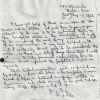
And all the while, Sidis's adherence to the
Okamakammesset principle of
anonymous contribution
further fed the journalistic
nonsense.
(See also
Notes on the Collection of Sidis's Pseudonyms.)
Sidis,
William James, AB. 1914; 8 Concord Ave., Cambridge, Mass.
From
Harvard Law School Directory
AN
ANNOTATED CHRONOLOGICAL BIBLIOGRAPHY
The following weaves an
annotated bibliography of Sidis's writings with another of news
articles about him during his lifetime. The only
book about him does not dispute the
failure myth. One reviewer wrote, "Amy Wallace ...
skillfully weaves vitality and wit into this very
unfortunate story of wasted genius." Not so! Well spent genius. Very well spent.
[William James to Boris Sidis,
letters and
postcards 1896 - 1907, Houghton Library,
Harvard University]
-------------------------------------------------------
We see that James occasionally
visited the Sidises.
Re W. J. he wrote: "Exercise his motor activities
exclusively for many years now. His intellect will
take care of itself." (James
Letters)
Boris was
one of James's students at Harvard, and
was
among the first to get the
new degree of Ph. D. in
Psychology .
At birth came his extremely
rare IQ, and a photographic memory.
Some news stories told of his ability to memorize trolley
schedules.
Then came a fine academic
home-schooling generated
mostly by himself, but
happily and ably aided by his parents
(e.g., his mother taught him
to how to spell as he learned
to speak).
Then came a, presumably, excellent education at Harvard
College, and then Harvard Law School.
(He completed two
years there and left in good standing.)
But declining any further
academic affiliation, his life-long
self-education and research
included hundreds of trolley-car
rides to
distant libraries and research sites.
Sidis
tried to lead a perfect moral life, and remained
celibate
as part of that goal.
He never spoke ill of anyone. His
guiding
principle was the ancient
wisdom of a Native-American
nation he had discovered under
foot in Middlesex
County,
Massachusetts.
An additional benefit of his
principled lifestyle was that he
avoided the common ad
hominem
fallacy of linking his
own great abilities
with the
truth
or falsity
of his writings.
(We readers must do the same.
We will judge the truth or
falsity of his writings
regardless of their author.)
A PHENOMENON IN KILTS
Boston Transcript,
Nov. 16, 1906
Massachusetts law required boys to attend school,
so he had to endure primary school even though
he already had a college-level education. The
article described his progress through grade
school.
One wonders why the 3rd and 5th grades took so
long.
|
"...the record
from the school register of his advance runs:
"First Grade -
Only a day or two.
Second Grade - A
few Days.
Third Grade -
Three months.
Fourth Grade - One week.
Fifth Grade - Fifteen weeks.
Sixth and Seventh Grades -
Five
and a half weeks.
Yesterday morning,
Headmaster. . . of the Brookline High School was persuaded to allow me
to see the boy at his work at school without letting him know that
anyone was looking at him."
|
This article, while admiring of him, is an
early example of invasion of his privacy.
This subject would come up again in a big
way 30 years later.
AN INFANT PRODIGY
North American Review,
1907, #184, 887-888
It wasn't long before
naysayers laid down what
would be a lifelong gauntlet.
"With this pathetic
eagerness for utterly
irrelevant knowledge, went
also an exaggerated reverence
for the written
word." Not so. In fact he had,
at an early age, an
eagerness for true knowledge
and reverence for
the truth.
At least the confused article
concluded with a
positive: "It is to be hoped
that the premature
development will not stop
short, but that the
disinterested love of
knowledge and of law may
solve some of this world's
scientific problems."
Such as the Second Law of
Thermodynamics.
The article also mentions he "spent
his summers at a
hotel in the mountains...It was his pleasing custom
to speak of all the guests in the house, in which he
spent his summers..." The guesthouse was
Shackford's in Albany, NH.

-------------------------------------------------------
DR. SIDIS OF BROOKLINE
Brookline
[MA] Chronicle, Mar. 7, 1908
Boris gets his M.D., becoming
perhaps the first to
have
both a Ph. D. in psychology and M.D. from Harvard.
His Ph.D. in psychology was
likely looked down upon
in the field of
psychopathology which was ruled by M.D.'s
with little knowledge or
understanding of the subject. It's
just that they had Rx
power. Boris's sarcastic opening
sentence in a 1899 talk to the American Medico-
Psychological Assn. was:
"I cannot help feeling grateful
to you for the
honor you have bestowed on me, a mere
psychologist, by your kind invitation to read a paper on
any subject in my line of work."
Nature
& Principles of Psychology
-------------------------------------------------------
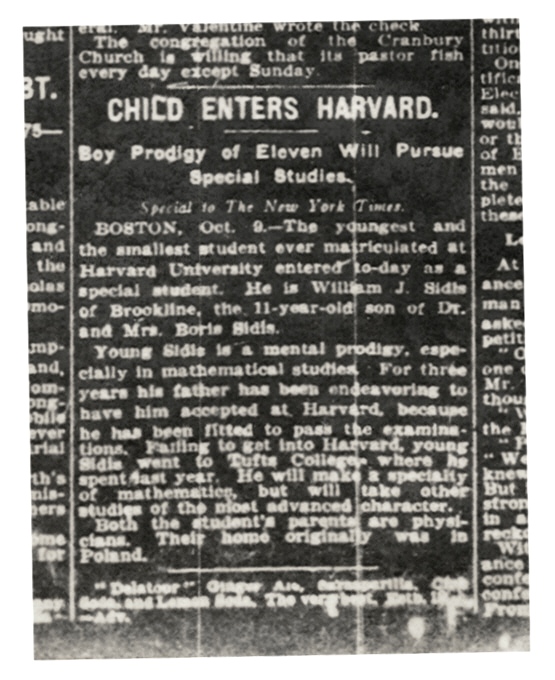
CHILD ENTERS HARVARD
Boy Prodigy of
Eleven Will
Pursue Special Studies
New York Times, Sunday,
Oct. 10, 1909, p.1.
-------------------------------------------------
He is front-page news in the
Sunday
Edition of this prestigious
international
newspaper:
"The youngest and smallest
student ever matriculated at Harvard,
entered to-day as a special student. He is
William
J. Sidis of Brookline, the 11-year-
old
son of Dr. and Mrs. Boris Sidis." The
Times went on to say
his parents were
originally from Poland. Not
true. They
were from Russia.
-------------------------------------------------------
HARVARD'S CHILD PRODIGY
All Amazed at Mathematical Grasp of
Youngest Matriculate Aged 13 Years
"Three years ago the boy first knocked at
the classic gates of Harvard for admittance,
but the powers that be refused him on
account of his youth."
New York Times,
Mon., Oct. 11, 1909, p.1
Front page news for a second day.
But the Times makes a major error:
he is not thirteen but eleven, as the
globally respected newspaper correctly
reported just the day before. His age
is the subject of the story, not his
entering Harvard, which would not
be of interest if he were 17.
-------------------------------------------------
We begin to see just how much falsity
can make its way into the news
.
The article goes on to tell how the registrar,
referring to previous attempts at admission,
asks: "What, again?" W. J. had passed
the entrance exams two years earlier but
was rejected because of his age. This year
was different however. There was now a
prodigy project. Boris had just delivered
"Philistine
and Genius" at the Harvard
Summer School graduation ceremony.
It dealt with the faults of the educational
system and urged early-childhood education.
It would come back to haunt him and his son.
The real story was early-childhood education.
-------------------------------------------------
A SAVANT AT THIRTEEN YOUNG
SIDIS KNOWS MORE ON ENTERING
THAN MANY ON LEAVING
A Scholar at Three
New York
Times, Sunday, Oct. 17, 1909, Pt.5, p.9
For the second time
the Times gets the central fact
wrong: his age! And things go downhill from
there:
"He is a Russian Jew―one is
tempted to write
'of course' after that sentence, so common are boy
wonders among the Jews, and especially among
Russian Jews." What follows is even worse: the
first signs of the Burnout Myth that would
persist
in the press
to his last day: "Child wonders are
usually looked on rather coldly and there are
always prophets to predict the sad end of precocity.
-------------------------------------------------
SIDIS COULD READ
AT TWO YEARS OLD
Under Father's Scientific Forcing Almost
from Birth
New York Times, Oct. 18,
1909


Boris has somehow managed to force genius.
-------------------------------------------------
SIDIS OF HARVARD
New York Times, Oct. 18,
1909, p.6
Asks intelligent questions about his
education. Decides reserve energy
is his secret power. Maybe so. But as
The Nation would soon
assert, it is a
case of unusual abilities at the far end
of the Bell Curve, combined with a pre-
school education and home schooling
and a student with a love of knowledge.
-------------------------------------------------
 SIDIS OF HARVARD
Youngest Freshman in the History of the College
Boston Sunday Herald,
Nov. 7, 1909, p.5
A picture is worth a thousand words. The distortion
of his image implies that there must be something
wrong with him.
He was not a freshman. He was admitted as a
special student in a experimental prodigies project.
A number of child prodigies from around the
country were "accepted" (assembled) to take
part in an experimental curriculum. The aim was
to educate them in such a way as to grant them a
real BA, not one with an asterisk. He was to take
a so-called Half-Course (Mathematics 6 1)
extended over a full year. He got a B.
He remained a special student for the next three
years taking a full course load, and was matriculated
as a senior in his fifth year in 1913. His
grades?
10 A's, 9 B's, 4 C's:
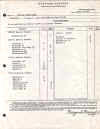
The senior class included one Richard Buckminster
Fuller who, upon receiving a copy of The Animate
and the Inanimate 65 years later, expressed
in a
letter
to Scientific American
his "...excitement and
joy that Sidis did go on to fulfill his promise."
--------------------------------------------------
ELEVEN YEAR OLD BOY LECTURES TO
MATHEMATICIANS
Answers Questions for Half An Hour; Talks
About Parallelopipedon and
Hectatonacosahedron With Utmost Ease
[Boston Globe
?],
Jan. 6, 1910, p.1.
Fragments: "In the games played in fourth-
dimension land the good player is he who can find
new short cuts in arriving at points, planes, faces
and sides. When you find a new short cut you get the
same pleasant sensation as when you are able to
fit two pieces into a jig-saw puzzle at the same time.
But the real situation is that we live in a
three-dimensional
world. We know length, breadth, and height. Suppose we...
had one more dimension, a fourth?
The easy manner in which, in his discussions, he
approached and passed over the word "parallelopipedon"
made the professors gasp, and when he began to coin
a few words and between breaths slipped out
"hectatonacosahedragon" [hectatonacosahedron?]...
After drawing figures and
proving theories until everyone
in the room was amazed, young
Sidis suddenly glanced
at his watch in true platform
style and brought his lecture
to a close. Then the
professors asked him questions for
half an hour."
--------------------------------------------------
Boy of 11 Astounds
Professors
Boston Transcript, Jan.
6, 1910, p.1
Front-page hyperbole. Only a
few
faculty were present, and none
said he
was astounded, though one thought
Sidis showed "great promise."
--------------------------------------------------
 
BOY OF TEN ADDRESSES
HARVARD TEACHERS
New York Times, Jan. 6,
1910, p.1
The Times gets his age wrong a third
time, this time lower rather than higher.
His age was the most important aspect
of the news about him at the
time.
--------------------------------------------------
Here are the minutes of that
meeting
of the Harvard Math Club.

[Collected
Minutes of the Harvard Math Club, p 93.]
--------------------------------------------------
ILLUSTRATING A SYSTEM OF EDUCATION
(letter to the Editor)
New York Times, Jan. 7,
1910, p.8
Young Sidis' Training (letter
to the Editor)
New York Times, Jan. 9,
1910, p.8
The Golden Age of Youth (letter to the Editor)
New York Times, Jan.
11, 1910, p.8

Readers begin to wonder about 'burnout'. It is
here we begin to see the public's role in what
a newspaper says. The burnout myth was a
public misconception. The media here reiterate
that misconception.
-----------------------------------------------------
Sidis An Avatar? (letter to the Editor)
New York Times, Jan.
12, 1910, p.8
Apparently not all its readers believed in burnout.
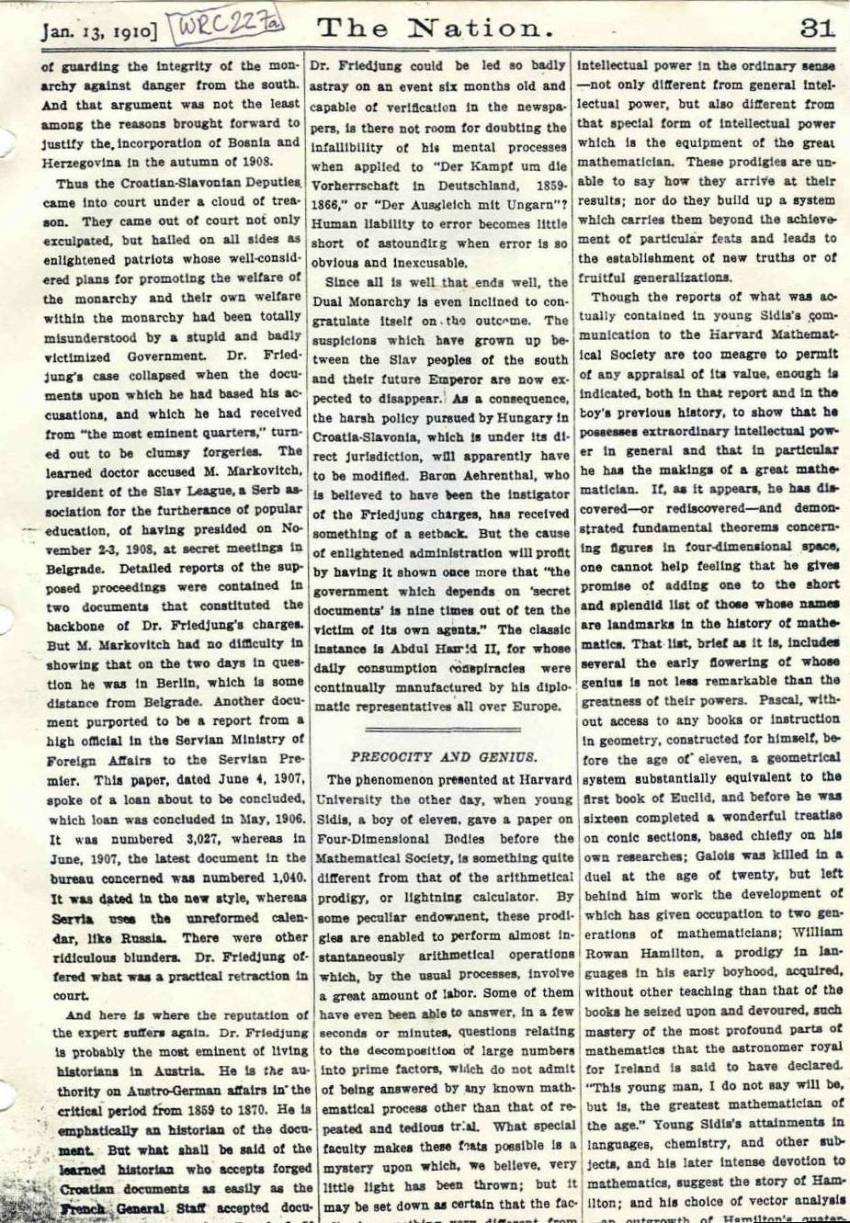
-----------------------------------------------------
Precocity and Genius
The Nation, Jan. 13,
1910, pp. 31-32
This article, possibly
written by the great
American philosopher Charles Sanders Peirce,
discusses nurture vs. nature.
The idea that
precocity―or at any rate precocity of any such character as this―generally
dies down into mediocrity has very little foundation. Some actually go so
far as to think that the very fact of unusual brilliancy in a child at so
early an age is a prophesy of little ability when he grows up; a notion that
rests upon the same fallacy as that which regards the children of highly
gifted parents as less likely to be highly endowed than other children. They
are vastly more likely to be thus endowed―as Galton conclusively
demonstrated in his "Hereditary Genius."
Another question raised in connection with young Sidis is that of training
versus native endowment. Dr. Boris Sidis, the eminent psychologist who is
the boy's father, is said to regard his son's achievements as indicating
that by proper methods of instruction several years could be cut off from
the time actually employed in bringing boys up to the college or
university stage. With the proposition itself we have no particular fault
to find; but that young Sidis's exploits serve in any degree to establish
it we deny without hesitation. The part played by native genius is so
manifestly predominant in this case as to nullify any general application.
This is evident on the face of the matter; but confirmation of the
strongest kind is given, if any were needed, in such precedents as those
of Pascal or Hamilton, both of whom made the amazing mathematical
conquests of their youth without any outside help whatsoever.
|
-----------------------------------------------------
He Has No Equal: William James Sidis
World's Most Wonderful Boy
Utica
[NY] Saturday Globe, Jan. 15, 1910
Article says, "Oh well, look
at his father
and mother. Dr. Sidis is a Harvard man
and has an international reputation for
his brilliant work...while his wife [Dr.
Sarah Sidis] holds the degree of medicine
and is wonderfully brilliant."


------------------------------------------------------------
Professor Sidis Assails Harvard Methods
Offers New Child Training Ideas
Fragment from Boston (?) newspaper,
Jan. 17, 1910.
Article about Boris's new book
Philistine and Genius
reads, "...or at least it is
supposed that [Harvard's]
President Eliot was referred
to..." There must have
been some Harvard brew-ha-ha
over this matter.
The average Harvard professor
doesn't get much
media attention at all, let
alone a taste of 15-minute
superstardom. But Boris was mainly questioning
the
educational system in and did not mention
Harvard.
This matter will reappear
shortly.
-----------------------------------------------------
Of Personal Interest
Boston Advocate, Jan.
17, 1910
" ... he is of extremely happy disposition,
brimming over with humor and fun. His physical condition is splendid, his
cheeks glow with health. Many a girl would envy his complexion. Being above
five feet four, he towers over the average boy his age. ... He is healthy,
strong, and sturdy.
|
------------------------------------------------

-----------------------------------------

THE OUTLOOK
A Weekly Newspaper
Vol. XCIV, March 5, 1910, p.545.
LETTERS TO THE OUTLOOK
Transcript
Harvard Calendar, 1910

------------------------------------------------------------
"Bending
the Twig"
by Harold Addington Bruce
American Monthly, 1910,
#69, 690-695
Writer Harold Bruce was a Sidis family friend.
------------------------------------------------------------

"Masters of the Mind"
by H. A. Bruce
American Magazine,
1910, #71, 71-81
Article about the major psychologists of
the time presents Boris Sidis and Sigmund
Freud as equal in influence. Boris strongly
argued against the fundamental assumptions
of psychoanalysis in a number of his books.
Freud made sure to ignore him.
---------------------------------------------------------
The Boy Prodigy of Harvard
Current Literature, 1910,
#48, 291-293
---------------------------------------------------------
"Boy prodigy and the Fourth Dimension"
by F. Fleischman
Harpers Weekly, 1910,
#54, 9

---------------------------------------------------------
Sidis Boy
Independent, 1910, #68,
162
---------------------------------------------------------
|
NOTES AND NEWS
Mrs. Martha S. Jones, of Boston, Mass., has presented her estate and
magnificent parks near Portsmouth, N. H., to Dr. Boris Sidis, of
Brookline, Mass., for the purpose of establishing a private hospital, to
be named 'The Maplewood Farms, Sidis Psychotherapeutic Institute,' in
which modern methods of psychopathology and psychotherapeutics will be
employed in the treatment of functional nervous diseases. The hospital
will open in the early spring.
[Psychological
Bulletin, 1910, 7, 75.]
|

Advertisement in
Journal of Abnormal Psychology,
1910

---------------------------------------------------------
Dr. Sidis To Open Novel Institution
Made Possible by Mrs.
Martha Jones Gift
New Bedford [MA]
Standard, June 25, 1911
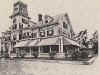 (Click.) (Click.)
The first of what was to
become known as residential
treatment centers. One of its
many innovations
was residential family
therapy.
---------------------------------------------------------
[Book review of]
Philistine and Genius by
Boris Sidis.
New York Times, June 25, 1911, p. 404
---------------------------------------------------------
Dr. Sidis In An Unkind Mood: His Vigorous
and Unkind Indictment of the American
System of Popular Education
New York Times, June
25, 1911, p. 402
-------------------------------------------------------------
Review of Boris's 10th book,
Philistine and Genius
in which he argued that education
should begin much earlier than
age five. He
added that "In every child
there is genius."
Dr. Sidis On Education
Boston Transcript, July
1, 1911
"Intellectual Precocity: Comparison Between
J. S. Mill and the Son of Dr. Boris Sidis"
by Tom Williams
Pedagogical Seminary,
1911, #18, 85-103
"Lightning Calculators"
by Harold Addington Bruce
McClure's Magazine,
1912, #39, 586-596
----------------------------------------------------------
Has picture of WJS but nothing
about him.
"Precocious Children" by Katherine
Dolbear
Pedagogical Seminary,
1912, #19, 461-491
----------------------------------------------------------
"The effect of his education seems to have been
to produce a boy who can do wonderful, even
brilliant reasoning but has difficulty in transferring
that reasoning power to everyday affairs. In a class
room at Harvard where a formula was being explained
the boy became bored and began to balance his
hat upside down on his head."
Academic statement of the burnout myth.
Portrait
McClure's Magazine,
1912, #39, 586
Portrait
Literary Digest, 1912,
#54, 514
"A Record of Experiments" by Joseph Hyslop
Proc. of Amer. Soc. of
Psychical Research,
1912, #6, 371-372
--------------------------------------------------------------
A subject in an experimental investigation of
psychic processes happens to mention Sidis.
The Dormant Waker
New York Times, Feb.
18, 1913, p.12
----------------------------------------------------
Discusses Boris's Psychology
of Sleep but refers to
him as "a Harvard Professor,
unnamed"
[Untitled]
New York Times, May 7,
1914, p.10
----------------------------------------------------
Leaks, a month early, impending
graduation of Sidis from Harvard.
Harvard A. B. At 16, William James Sidis,
the youngest student to get degree there
New York Times, June 14, 1914, p.1
----------------------------------------------------------
His
transcript indicates he was given no
special treatment and that he did well
enough on his exams and other
requirements to graduate
Cum Laude
at the age of an average high
school senior.
Sidis, W. J.,
Unconscious Intelligence
Appendix IV of
Symptomatology,
Psychognosis, and
Diagnosis of
Psychopathic Diseases
by Boris Sidis
Ph.D., M.D. Boston: Badger,
1914, 432-439.
------------------------------------------------------
Presents a logical argument
against the
foundations of
psychoanalysis.
|
The subconscious has
been explained in two ways; according to one of these, the phenomena of the
subconscious are manifestations of a consciousness, possessing all the
attributes of intelligence and other adaptations that any consciousness
possesses, while according to the other theory there is behind these
phenomena an "unconscious intelligence" which has all the properties of
intelligence, but which somehow or other is not conscious. |
He argues that psychoanalytic
theory makes a classic
scientific error by assigning different causes
to the same
effects. The effects caused by
a psychoanalytic
'unconscious' and the effects
caused by conscious
processes, "...have no points
of difference sufficient
to justify a difference in
explanation (p. 435)."
Unconscious Intelligence
This Plan Is Full Of
Promise
New York Times, April
24, 1915, p.10
------------------------------------------------------
Subtly hints at 'burnout'.
'14 - William James Sidis
Is A Fellow In
Mathematics (instructing)
at the Rice
Institute, Houston, Tex.
Harvard Alumni Bulletin,
Oct. 20, 1915
--------------------------------------------------
Being constitutionally unable
to be
a faculty member, then or
thereafter,
he returned to Boston and
entered
Harvard Law School.
"A Twelve Year Old Boy
Wonder Child"
by R. H. Moulton
American Magazine, Feb.
1915, #79, 56-58
"Portrait"
Illustrated World,
1915, #24, 49
"William James Sidis, the
Harvard Prodigy
Who Graduated At 16, as he
looks today
(caption under photo)."
Fragment from Boston
Sunday Herald
------------------------------------------
Bruce, Harold Addington
The Riddle of Personality
NY: Moffat Yard, 1915, 88-93
Bruce offers a 'bending the
twig'
theory of education.
------------------------------------------

------------------------------------------
'Nerves' and Experts On
What To Eat:
Dr. Boris Sidis Considers
Abnormal
Psychology Exaggerated
Heredity
Boston Herald, March
24, 1917
-------------------------------------------------------
A complete confusion of
Boris's theory
that genes play a major part
in our
makeup and his distinction
between the
'abnormal' and the
'pathological' in his
masterwork
The Foundations of Normal
and Abnormal Psychology
: "The
abnormal is the normal out of
place [e.g.,
walking is normal but not
while asleep], the
'pathological' is the normal
under extreme
conditions [e.g., excessive
cleanliness]
Boris Sidis Archives
[Transcript from Harvard Law School, 1917]
That he also completed two
years at Harvard Law,
was never mentioned by the press.
Sidis, William "A Remark on
the Occurrence of
Revolutions" (with foreword
by Boris Sidis)
Journal of Abnormal
Psychology, 1918, 13, 213-228
--------------------------------------------------------------------------
Sidis remarks on a statistical
correlation between sunspot
cycles the occurrence of
revolutions.
|
However, I
do not wish to be understood as saying that the sun-spots
cause revolutions. An appearance of
sun-spots could not, by itself, produce revolution unless other circumstances
are already such as to cause the revolution. All such revolutions would occur
anyway, even without the sun-spot variations; but these sun-spot variations
superadd natural extremes of climate, causing not only physical discomfort but
danger to life and health, thus hastening a revolt that might otherwise have
waited for a very long time."
|
Revolutions
Arrest 114 Men and Women
In Connection with Riot
Boston Herald, May
3, 1919
--------------------------------------------------------------
"Riot" = peaceful protest.
Arrest 102 In Roxbury
Boston Transcript,
May 3, 1919
Four Boston Radicals Get
Prison Sentences
New York Times, May
3, 1919

Boston Rioters' Cases
Disposed Of
Bangor
[Maine]
Commercial, May 3, 1919
Sidis Gets Year And Half
In Jail
Boston Herald,
May 14, 1919.

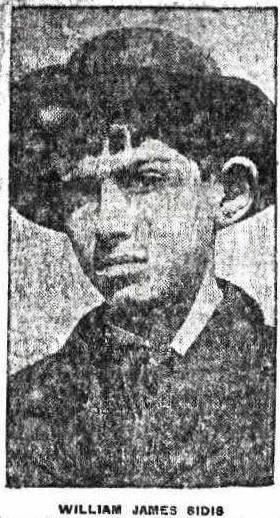
Distortion of his beliefs and
picture notwithstanding, this article
details his testimony in the
trial that focused on his beliefs.
Interestingly, his political
socialism at age 21seems based on
the Declaration of
Independence and government by consent of
the governed. His later
libertarianism and pacifism were based
on the same principles of the
primacy of individual rights. Click
the picture or the link above it for full text
of this article.
Young Sidis, "Harvard
Prodigy," Sentenced
To A Year And A Half In
Jail For Rioting
New York Times, May
14, 1919, p.1
 
--------------------------------------------------------------
He served the time in house
arrest supervised
by his parents. See his reaction to it in
"Railroading" in the Past
A Youthful Prodigy In
Trouble
New York Times, May
15, 1919, p.16
Genius Early Revealed
New York Times, May
15, 1919, p.16
Burnout myth grows. Having taken
part in an anti-draft
demonstration
suggests burn-out.
------------------------------------------------------
JUNE 3, 1919

------------------------------------------------------
Boris Sidis The Harvard
Boy Prodigy A
Candidate To Serve Out A
Jail Sentence
Is A Candidate For
Attorney General of
Massachusetts
Lowell
[MA] Courier-Citizen, June 11, 1919
Article states, "He stands to
know a few
things about the law before
he gets through."
This was a period of high
activism and personal
profile in public life. His
declared "candidacy"
was a symbolic act to make a
point.
April 25, 1923: Prosecutor will not proceed
with case.

------------------------------------------------------
[Tuesday, January 6, 1920.
Sidis completes
The Animate
and the Inanimate,
and then waits five years to publish it
(see below.)]
"The Secret Of Sound Sleep"
by Boris Sidis M.D., Ph.D.
American Monthly,
Dec. 1922, p.36
---------------------------------------------------
This
article, one of more
than 50, was his last.
Dr. Boris Sidis Dies
Suddenly
Portsmouth
[NH]
Herald, Oct. 25, 1923
Dr. Boris Sidis Dies
New York Times, Oct.
25, 1923, p.19
Precocity Doesn't
Wear Well
New York Times, Jan.
11, 1924, p.16
-----------------------------------------------------
More 'burnout' myth.
Sidis Inherits $4000,
May 23, 1924
----------------------------------------------------
Documents
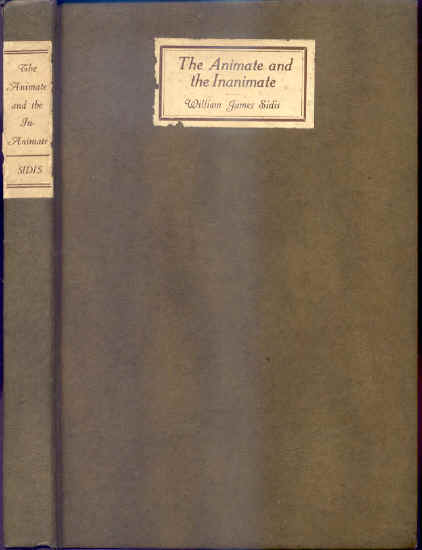
Sidis, W. J.,
The Animate and the Inanimate.
(Boston: Badger, 1925).
----------------------------------------------------------------
He begins the first chapter of
this earthshaking work with a
remarkable discovery of what
might be called the first law
of physical laws, modestly
presented:
|
Among the physical laws it is a general characteristic that there is
reversibility in time; that is, should the whole universe trace back the various
positions that bodies in it have passed through in a given interval of time, but
in the reverse order to that in which these positions actually occurred, then
the universe, in this imaginary case, would still obey the same laws.
|
The only physical law that
does not meet the reversibility
requirement is the second law
of thermodynamics. And
therein lies a great secret:
|
In the theory herein set forth, we suppose that reversals of the
second law are a regular phenomenon, and identify them with what is generally
known as life. This changes the idea of unavailable energy into that of a
reserve fund of energy, used only by life, and created by non-living forces.
Hence, in the last analysis,
the second law of thermodynamics is to be interpreted as a mental law, as the
law determining the direction in which a given mind will conceive of time as
flowing.
|
His discovery has immense
ramifications for the way we
understand the universe and indeed ourselves. In Chapter 3,
he presents a devastating argument against the still popular
Big Bang theory. He concludes that the highest probability is
that the universe is infinite and eternal as per the First Law of
Thermodynamics: energy is neither created nor destroyed;
and that the second law of thermodynamics is a psychological
law governing the way we perceive the universe. There are
other more mysterious ramifications such as the continuity of
consciousness after physical death, but this last matter must be
left to time.
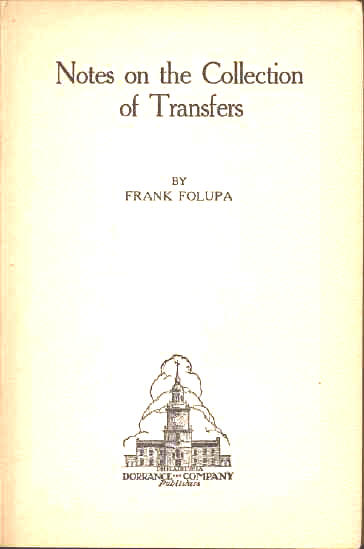
Sidis, W. J.
Notes on the
Collection of Transfers
by Frank Folupa (pseud.)
Phila.: Dorrance, 1926
From Introduction:
|
This book is a description of
what is, so far as the author is aware, a new kind of hobby, but one which seems
on the face of it to be as reasonable, as interesting, and as instructive as any
other sort of collection fad. This is the collection of streetcar transfers and
allied forms. The author himself has already collected over 1000 such forms,
there being no duplicates included. We have been very much tempted to give this
process of transfer collection some special name, similar to 'philately,' for
stamp collection, and 'numismatics' for coin and medal collection.
Consequently, we went so far as to coin the term 'peridromophilly' for the
general subject of transfer collection, and concurrently with this,
'peridromophile' for the transfer collector.
|
As usual, Sidis is modest
about the importance of his work.
The book preserves for
posterity a complete record of the US
trolley-car
system of the 1920s. The press, apparently
without exception,
saw it as further evidence of his 'burnout'.
But
Notes on the Collection
of Transfers is taxonomy
Aristotelian in breadth and detail.
The transfers were collected while he was "riding
his hobby"
in order to research the Tribes and the States at
the local level.
Many suggestions have been made re his pseudonym.
Perhaps
Frank = French, and Folupa = fallu
pas (wasn't practical or necessary).
Russia Has Opportunities:
Dr. [Sarah] Sidis
Recently Returned from
Foreign Land Says
Wages of People High, Art
Appreciated,
But Bread Is Scarcity
Manchester
[NH]
Union, March 4, 1929
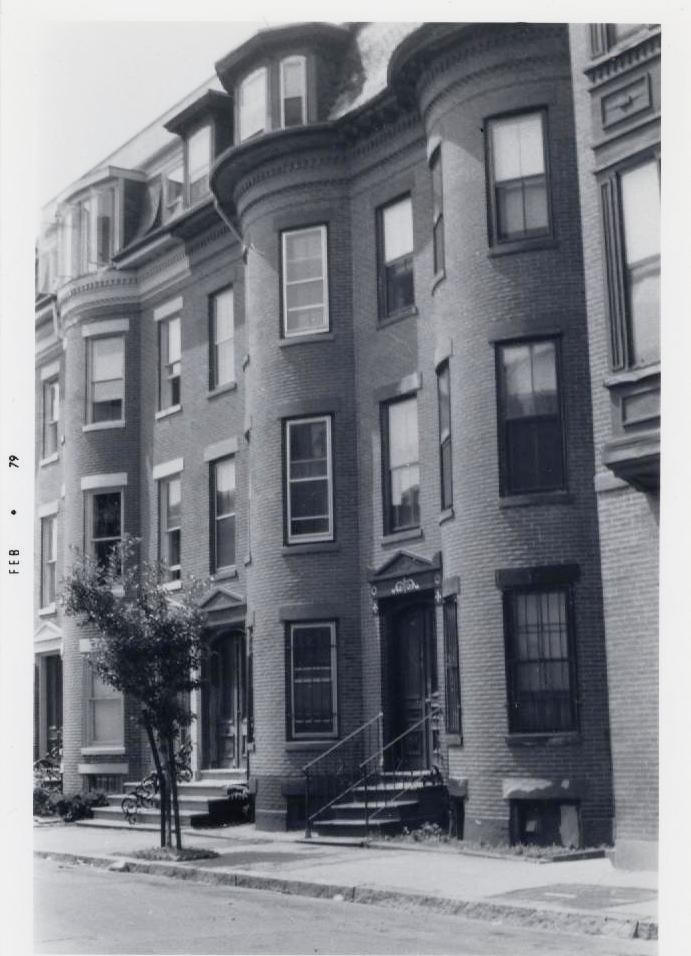
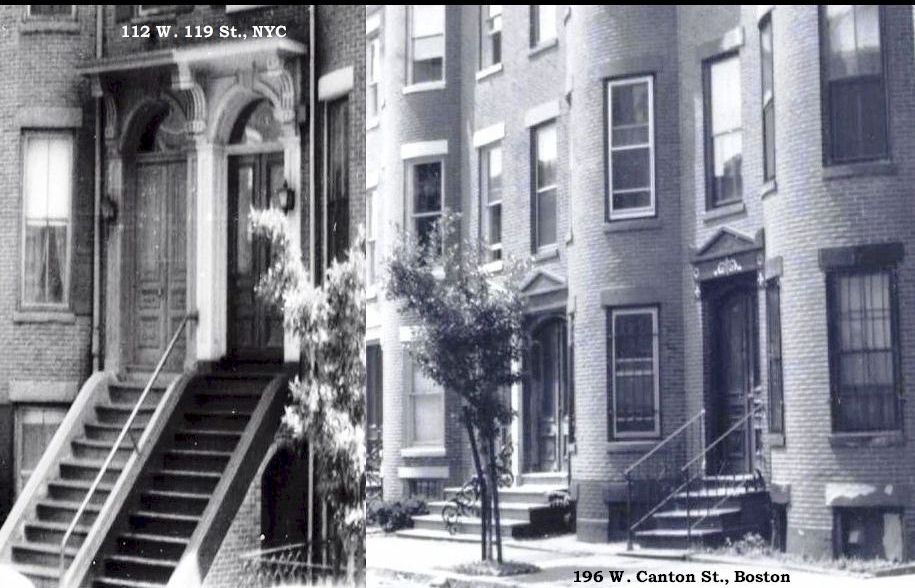
196 West Canton St., Boston (ca 1981)

112 W119, NYC Today
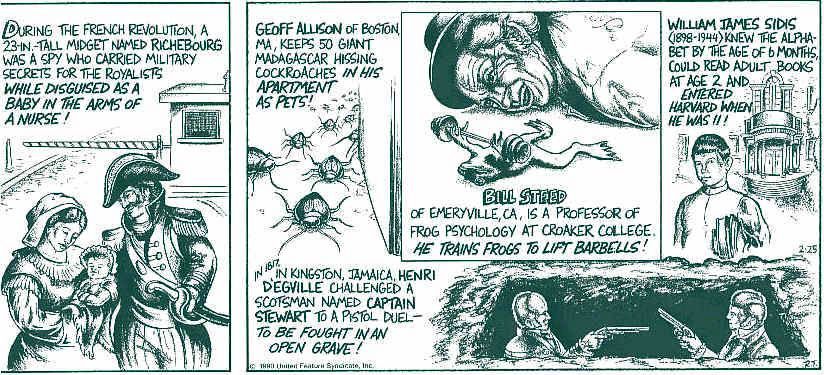
[Ripley's Believe Or Not]

Sidis, W. J.,
Perpetual Calendar
US Patent No. 1,718,314 , June 25,
1929
US Index of Patents, 1929, 658 - 660.
US Patent No. 1,784,117, Dec. 9, 1930
US Index of Patents, 1930, 638 - 640.
------------------------------------------------------
His great discovery is (1) a mere 56 calendars are
necessary for a perpetual calendar, and that (2)
they can be quite simply organized within a circle
which rotates within a surrounding square.
|
The
invention relates to perpetual calendars in which week-days can be found
directly for any given date whatever; and its object is, first, to provide
a means by which all such weekdays can be looked up in a direct, simple,
and easily understandable manner; secondly, to avoid the cross-reference
tables or complex mechanism, one or the other of which have hitherto
generally been features of perpetual calendars providing means to look up
the week-day of any given date whatever; thirdly, to provide a perpetual
calendar in which, once the calendar is adjusted for any given year, a
complete and condensed calendar for the year is plainly visible; fourthly,
to simplify the parts and their interrelation by the elimination of
indicators or pointers which add to the difficulty and expense of
manufacture and to the derangement of the operation of the calendar. |
Dare anyone dream of the
royalties
for this invention? Better
yet, dare
anyone dream of inventing such a
device after so many great
mathematicians
had failed to do so?
Patent
Photo
Sidis, W. J.
The Orarch
A newsletter on liberty and
related subjects.
Orarchy = limited government,
as opposed
to anarchy = no government.
Sidis was by this
time a 'libertarian', maybe
the first to use the term.
He may be hinting at this in:
The Modern Gray Champion.
Sidis, W. J.,
The Tribes and the States
by John
W. Shattuck (pseud.),
ca. 1932. Unpub. ms. 620 pages.
There are certain
definite departures from the common and well-known points of view regarding
America and its past that the reader will notice. At the opening, it is
obvious that the beginnings of American history are sought not in Europe but
here in America, among the peoples who originally inhabited this country.
The
material is partly the legends and traditions of the tribe itself, some of which
are embodied in its poems, which are freely quoted throughout this history;
partly well-known historical facts and dates, as interpreted from this different
point of view; partly facts which are definitely known but which the
ordinary history fails to bring out because varying from the standard "patriotic
point of view―all originally presented by the "tribe" as isolated material, but
in this history for the first time woven into a continuous whole.
---
There are other points of
difference from the established text-book view of history, such as: picturing
America as a country where popular revolts have been the rule rather than the
exception, and even as the origin and inspiration of such revolts throughout the
world; describing George Washington, not as the hero of the American Revolution,
as he is ordinarily considered, but rather as one who had little sympathy with
democracy, and finally overthrew by conspiracy the republic the Revolution
established; the existence of a First Republic (John Hancock being its first
president) representing the American Revolution, and a Second Republic
representing a political counter-revolution; the pre-revolutionary co-operative
factory and civil disobedience systems in Massachusetts; or the various peculiar
theories of economic and political functions and development as presented here.
|
At the heart of this
extraordinary history of North
America from prehistoric
times is Sidis's
Continuity
Theory:
|
The history is thus not a
history from the point of view of ancestry, but rather of locality. The idea
developed is that in each locality there is a certain continuity of tradition
that persists in spite of the changing character of its population—not that the
geographical characteristics compel this, as some have supposed, but rather that
each successive wave of invasion or immigration acquires the traditions from the
previous inhabitants of the region.
*
In America, as in most cases of this sort, the original institutions of the
place not merely have a strong influence on the new people and guide them to the
formation of their own societies, but, in so far as they are displaced, show a
strong tendency to come back . |
To this day, twenty-six American states
retain their Native-American
names. The Massachusetts state flag depicts a red man, and even
the Mass. Confederacy, the first white democratic government in
America, adopted a red man as its symbol. Not to mention
the concept of federation invented by the Iroquois
(Hodenosaunee) which is still spreading around the world
today, and well-established in the rotating presidership
(presidency) of the UN Security Council.
Sidis's sources for the history of the red people were:
|
"The various designs of
the colored beads in a wampum belt expressed ideas as definitely as any form of
writing; and tribal history, minutes of meetings--even personal letters, were
written by weaving wampums to express the ideas intended to be conveyed(Chapter
III)." |
The Tribes and the States
Out Today: Harvard
Prodigy
New York World Telegram,
Aug. 13, 1937, p.15
Reports publication of infamous
New Yorker article.
--------------------------------------------
"Where
Are They Now? April Fool"
by Jared L. Manley
The New Yorker, August 14, 1937, 22-26
----------------------------------------------------------------
This article, written by James Thurber, was central to a
a well-known US
Supreme Court decision in 1941. It implied
that Sidis's enthusiasm for the Okamakammessets
was evidence of burn-out. As to "April Fool," he
was born on April 1. Many celebrities, such as Carol
Burnett, have lost invasion-of-privacy cases due to the
legal precedent set by the Sidis case. And paparazzi
cases with many movie stars.
Sidis, W. J.,
Atlantis
ca. 1937. Unpub. ms. missing.

--------------------------------------------
No Privacy for Prodigy
New York Times, Dec.
17, 1941, p.21
Reports US Supreme Court decision on Sidis's case against
The New Yorker magazine for having violated his rights to privacy in its
1937 article. He had not assented to an interview. Sidis probably personally
funded his case.
--------------------------------------------
Sidis vs. F-R Pub. Corp
Federal Reporter,
1941, #113, 807-811
In a 5 - 4 opinion, hence by the vote of a single
Justice, the US Supreme Court decided that fame
cast upon one's shoulders the burden of losing
one's rights of privacy. Chief Justice Brandeis, the
deciding vote, said The New Yorker article was,
"...merciless in its dissection of intimate details
of its subject's life," and further admitted that
ALL have the "... right to be protected from
the prying of the press..." But he proceeded to
deny Sidis that right because he was a public
figure! This case set the precedent which has
come up time and again in celebrity libel cases
against the press.
--------------------------------------------

"Meet
Boston" by Jacob Marmor (pseud.)
What's New In Town,
Jan. 3, 1941 - Sept. 18, 1942
---------------------------------------------------------------------
89 weekly columns on
interesting and little known
facts about Boston and its
history. First week was
titled "Strange But True."
(Marmor was Boris's
mother's maiden name.)
--------------------------------------------
Peridromophily and Mr. Willie Sidis
The Evening Sun
(Baltimore), Jan. 8, 1943
"Peridromophily" was
Sidis's name for his
hobby of collecting trolley-car transfers.
--------------------------------------------
One Time Child Prodigy Found Destitute Here
Boston Traveler, July 14, 1944, p. 1
--------------------------------------------
Hub Prodigy Who Held
Clerk's Job Dies Penniless
Boston Traveler,
July 17, 1944
Most Bostonians
considered their lovely city to be
the Hub of the Universe then.
Perhaps it was.
--------------------------------------------
Landlady Tells How Sidis
Was Stricken
Boston Traveler,
July 17, 1944
--------------------------------------------
Sidis A "Wonder" In
Childhood Dies
New York Times, Wednesday, July 18, 1944. p. 21
 "...
apparently destitute ... "
It is just amazing how the New York Times,
respected around the world for the quality
and accuracy of its journalism, could so often
print mistakes re W. J. Destitute? He had
$652.81 in his bank account. That amounts
to
$8,674.84 in 2013.
--------------------------------------------
Sidis Once Prodigy Dies
In Hospital In Obscurity
Boston Herald, July
18, 1944
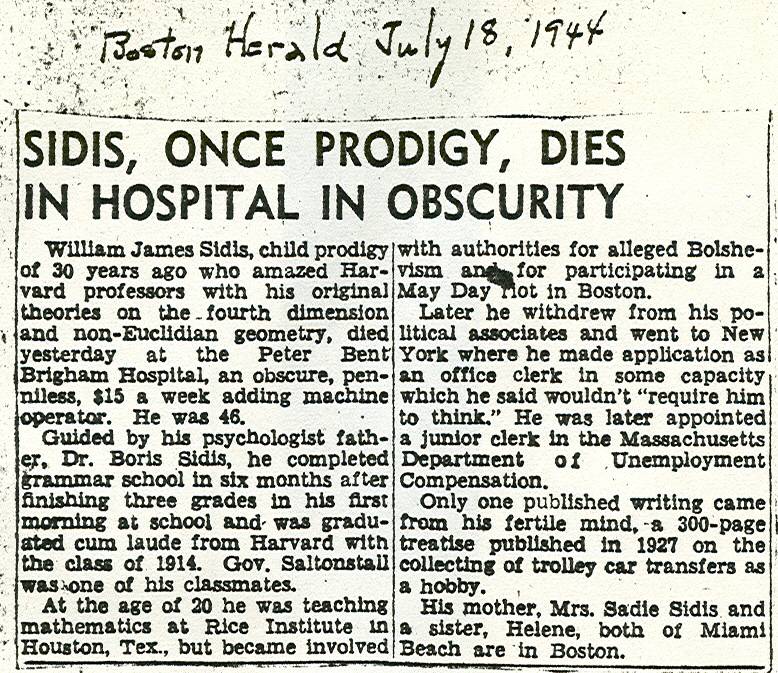
His death after a lifetime of
press
attention was international
news.
--------------------------------------------
The Hidden Genius
New York Times,
Wednesday,
July 19, 1944, p.18
'Burnout' one last
time.
--------------------------------------------
"Sidis' Boyhood Seen Case
of All Work
and No Play" by Alice
Burke
Boston Traveler, July 19,
1944
--------------------------------------------
"Sidis Was Victim Of An
Experiment"
by Shirley S. Smith.
Boston Traveler,
July 19, 1944
--------------------------------------------
"What Happened To One
Child Prodigy"
by Ruth Reynolds
New York Sunday News,
July 23, 1944, 38-41;
"Taught Son Everything But
How To Live"
by Ruth Reynolds
Boston Sunday Post,
August 6, 1944
Same article, different
titles.
--------------------------------------------
Prodigious Failure
Time, July 31, 1944,
#44, p.60
To entitle an obituary of any human being
in this way makes this a low point in the
history of journalism. An apology has long
been in order given the prestige of this
periodical.
--------------------------------------------
Burned Out Prodigy
Newsweek, July 31,
1944, #24, 77-78
--------------------------------------------
"William James Sidis" by
Hallowell Bowser
Saturday Review,
July, 1944
--------------------------------------------
Psychology for the Millions
by Abraham Sperling, Ph.D.
NY: F. Fell, Inc., 1946,
332-339.
City College of New York
professor was
the first Sidis biographer.
He visited Helena
Sidis and tells of
having seen a dozen
manuscripts written by
Sidis. See also
Re Atlantis Manuscript
Re Philology & Anthropology Mss.
--------------------------------------------
In a letter
to Julius Eichel, who had been
a friend of Sidis,
Sperling wrote:
|
Also
I am thoroughly familiar with his desire to avoid publicity and his friends'
wishes to observe that
desire. However, since the appearance of so many distorted
news and magazine articles about Bill
since his passing, a true
and worthy account of the noble
spirit and motives that guided Bill Sidis
through
life is more than justified (Monday, June 25,
1945).
|
Amen to that!
Home
Page
Sidis FAQ
Greek Translation

|
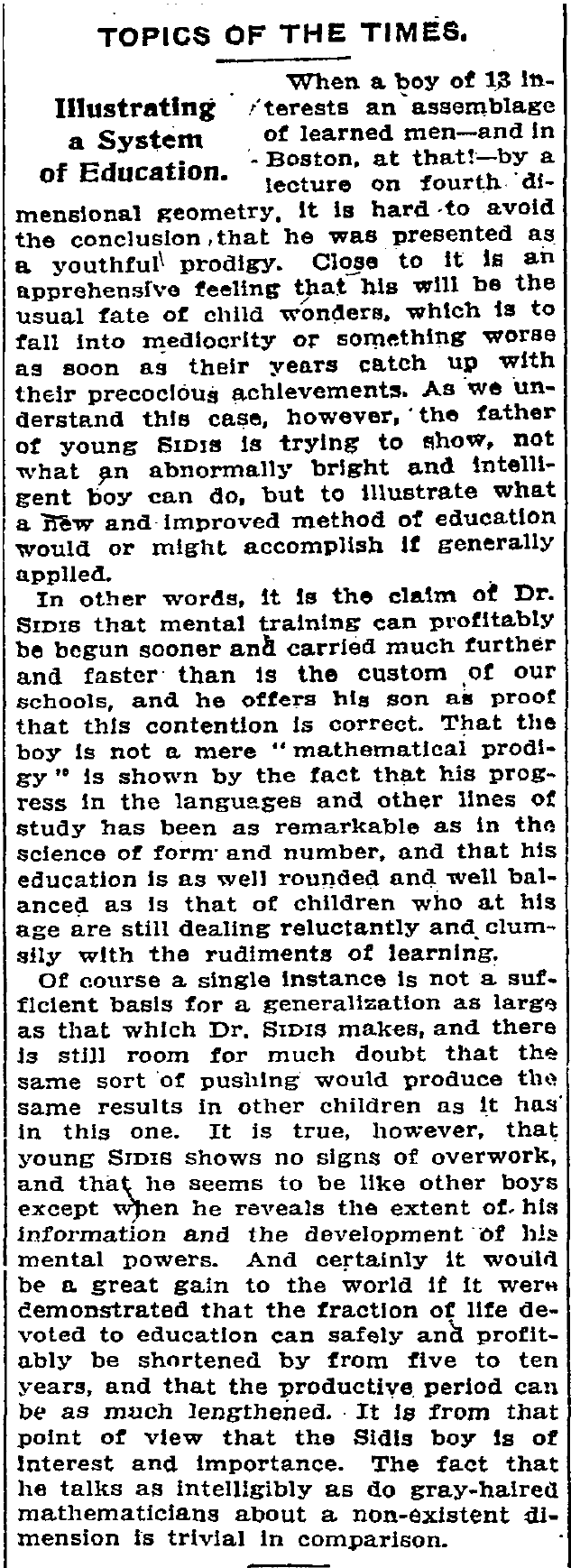
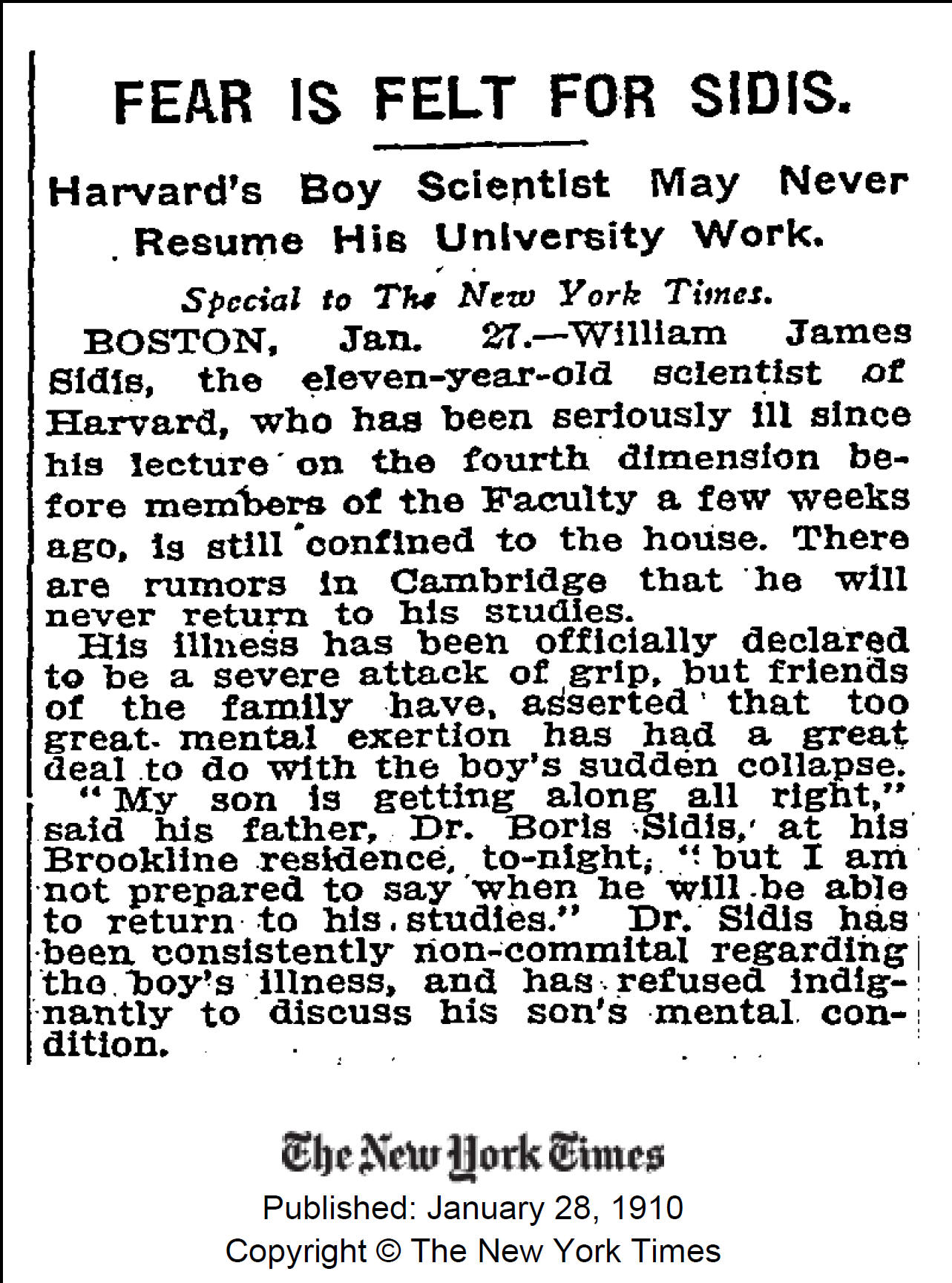


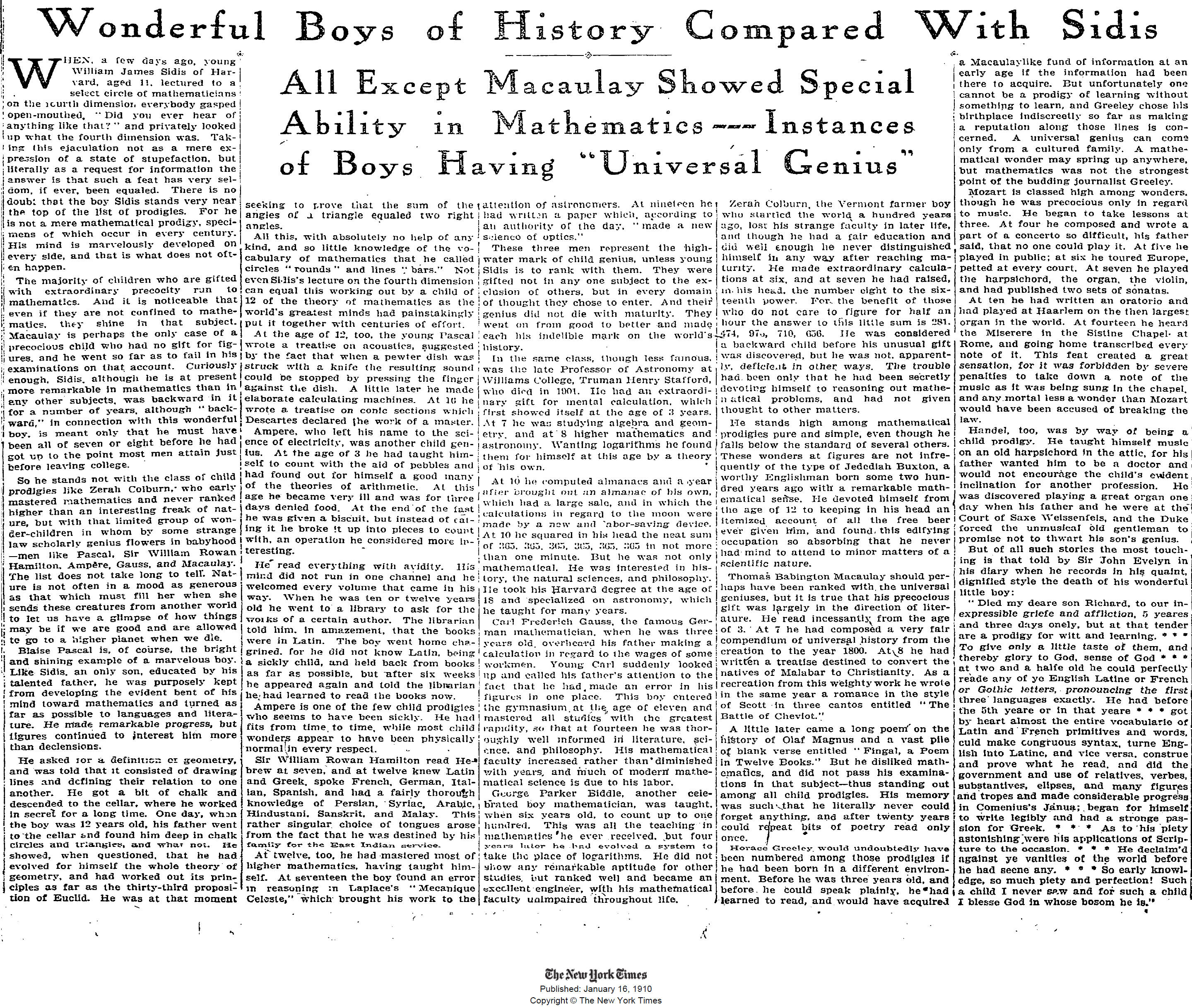

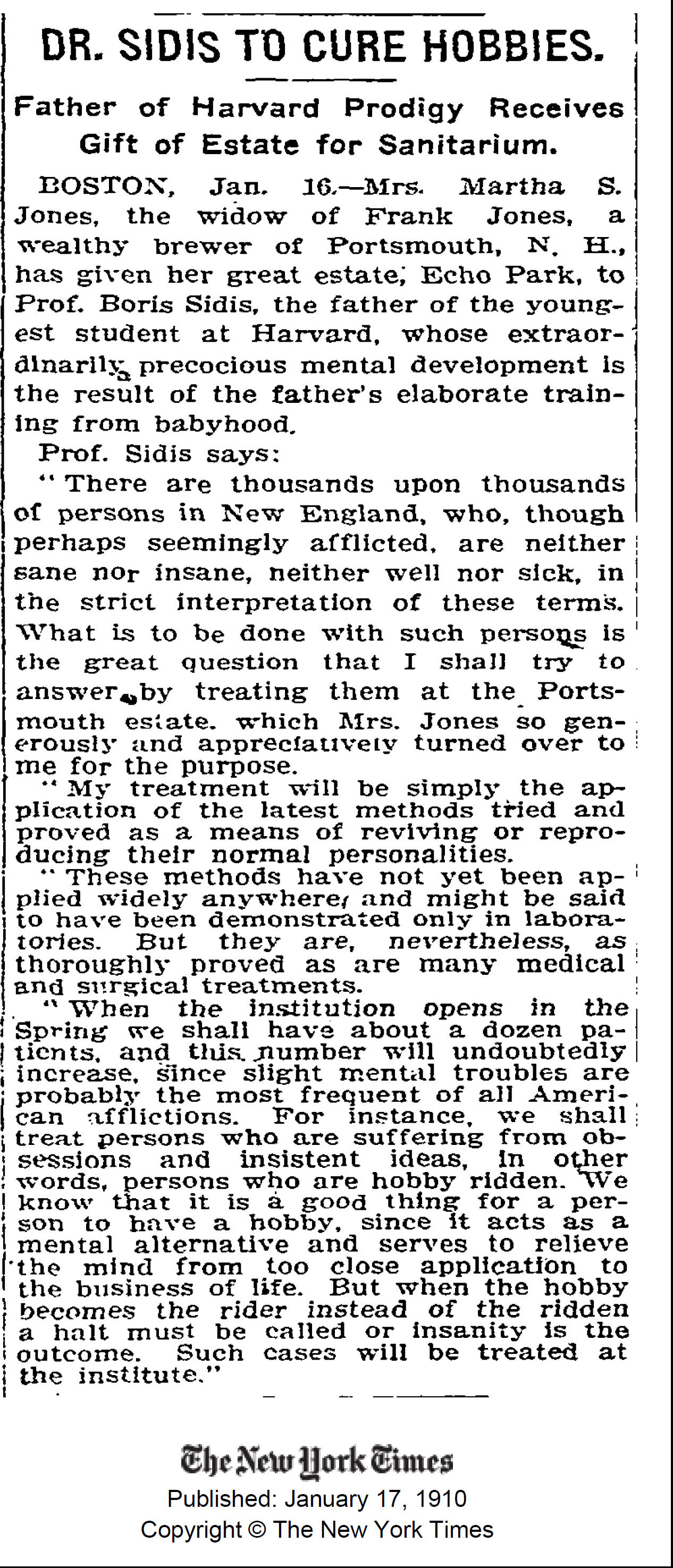





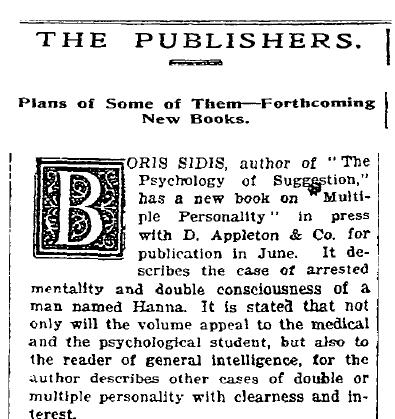
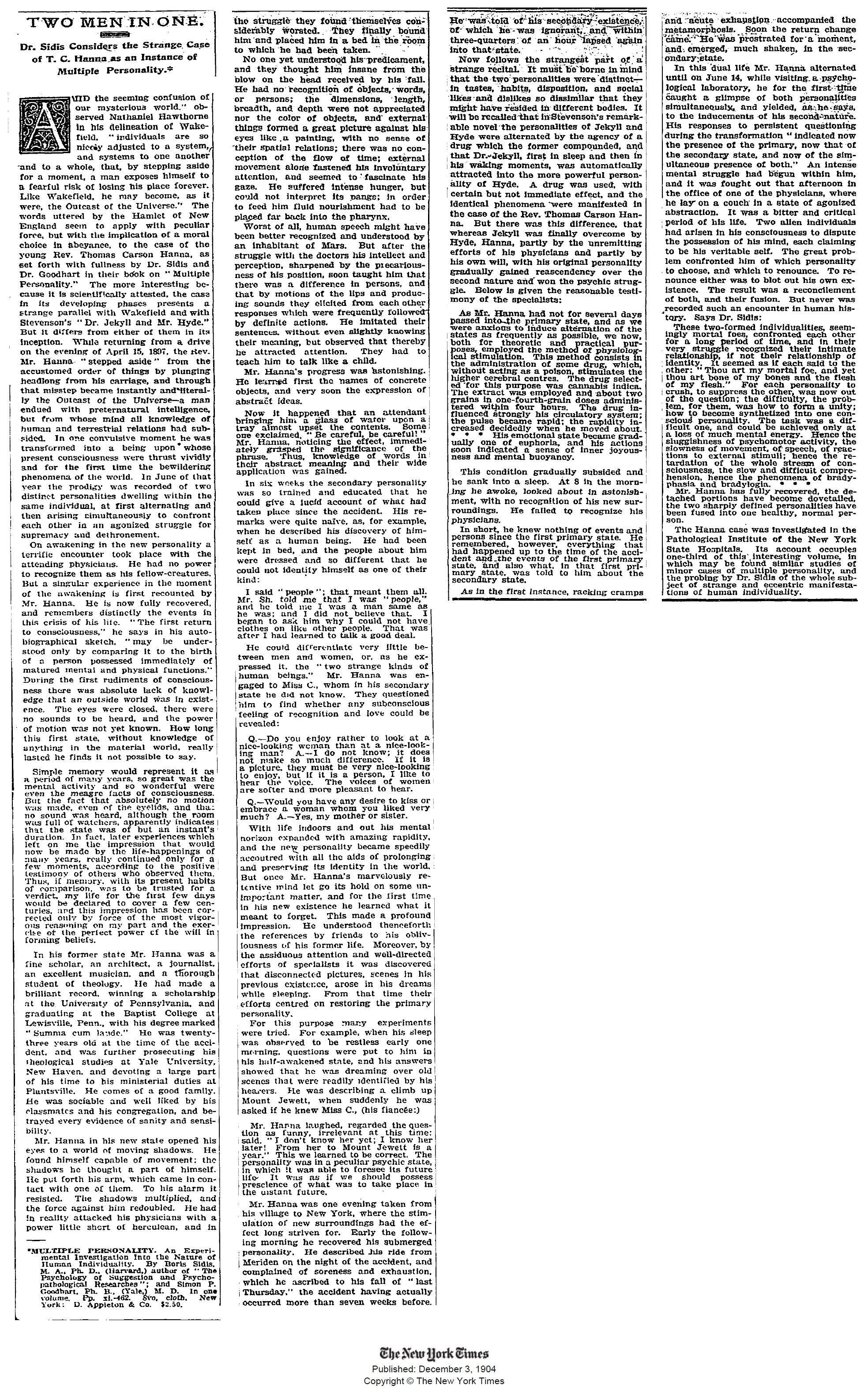

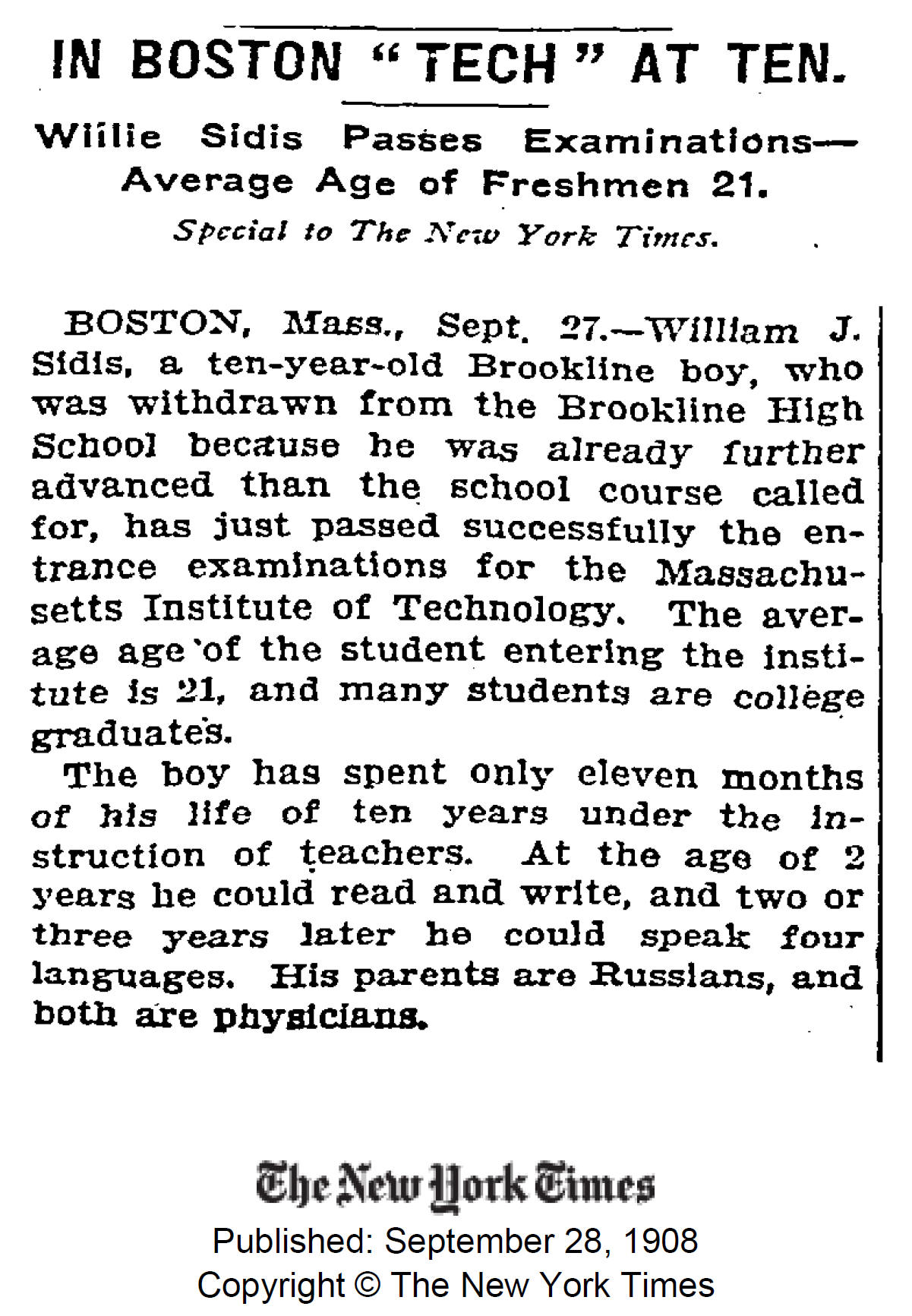

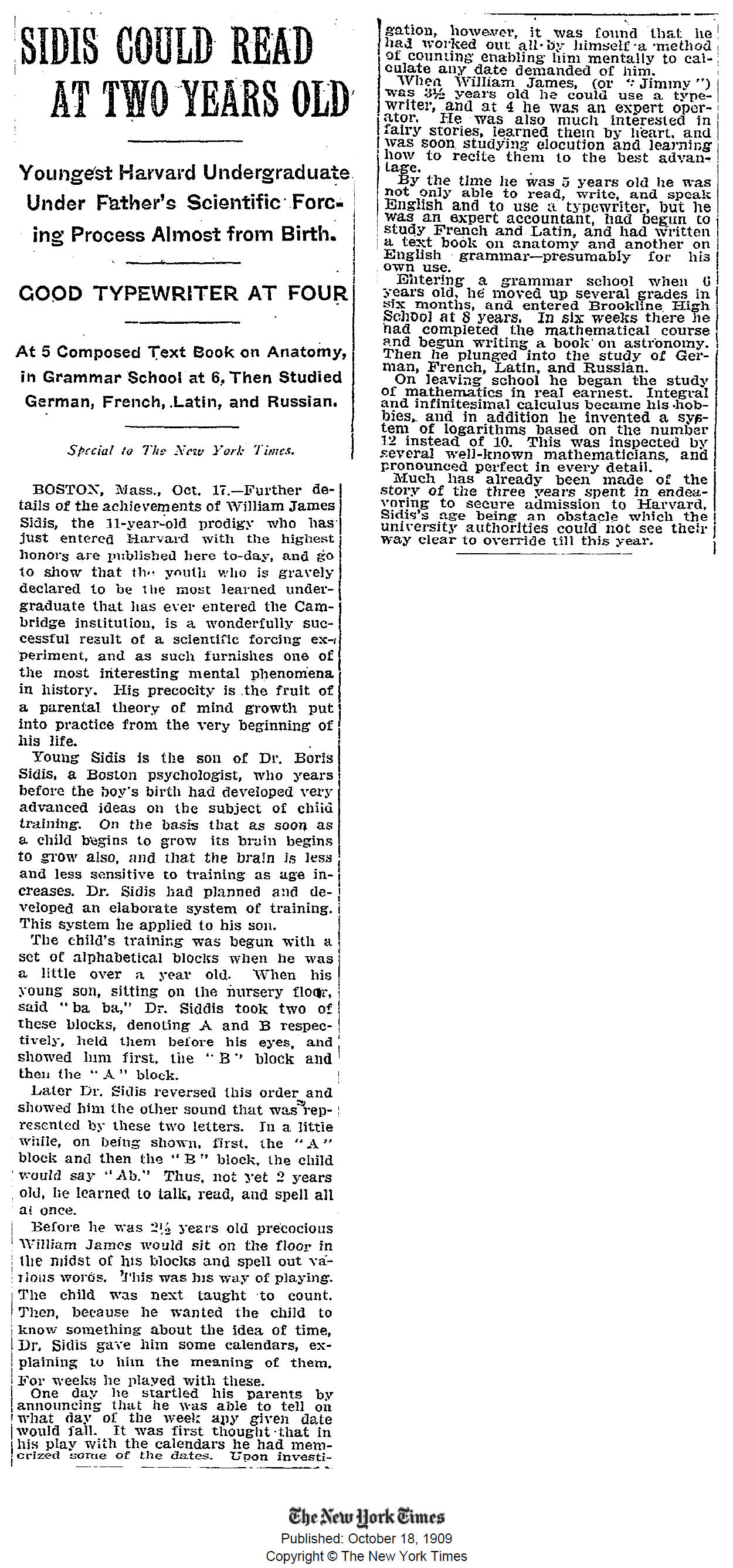

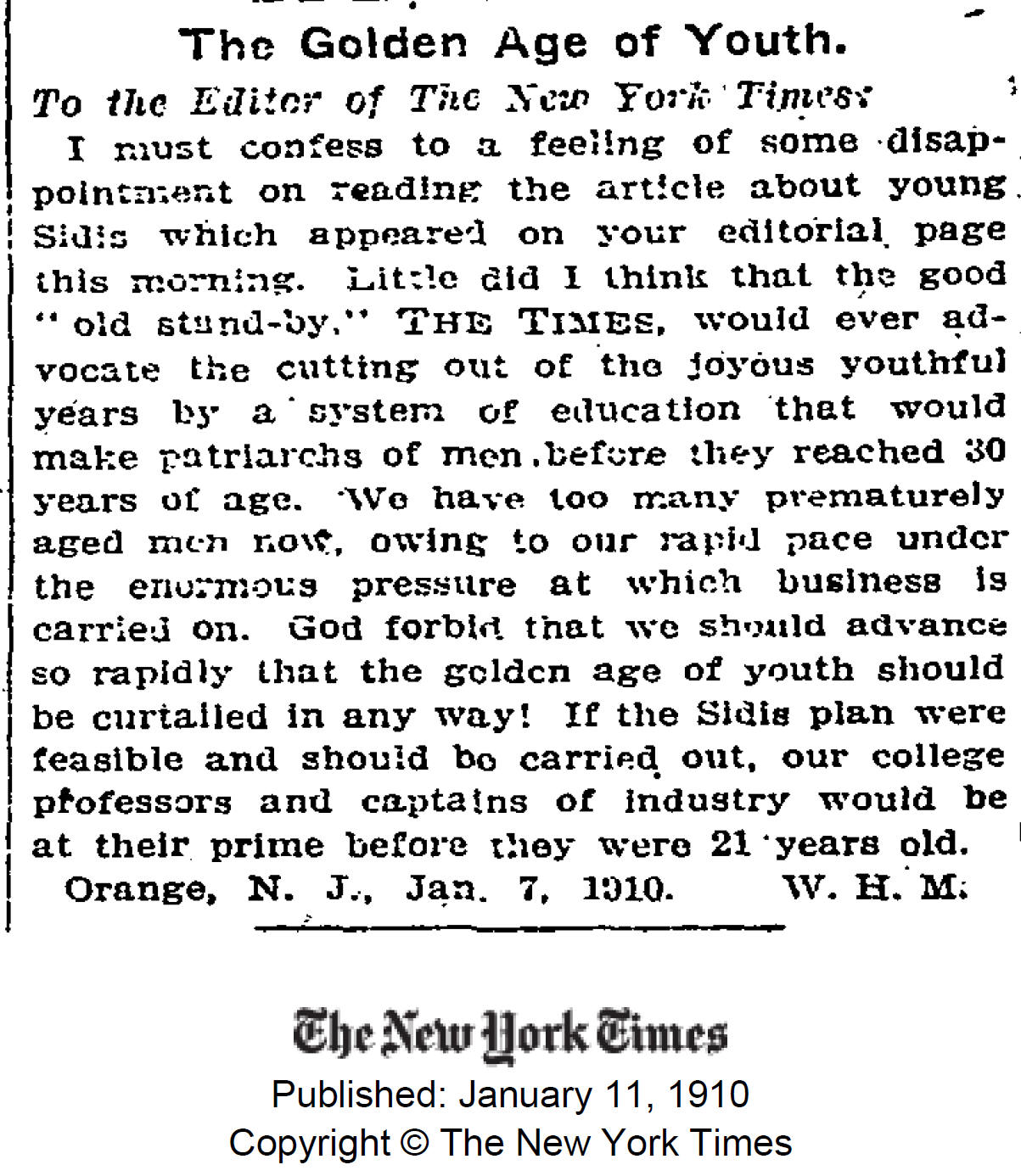

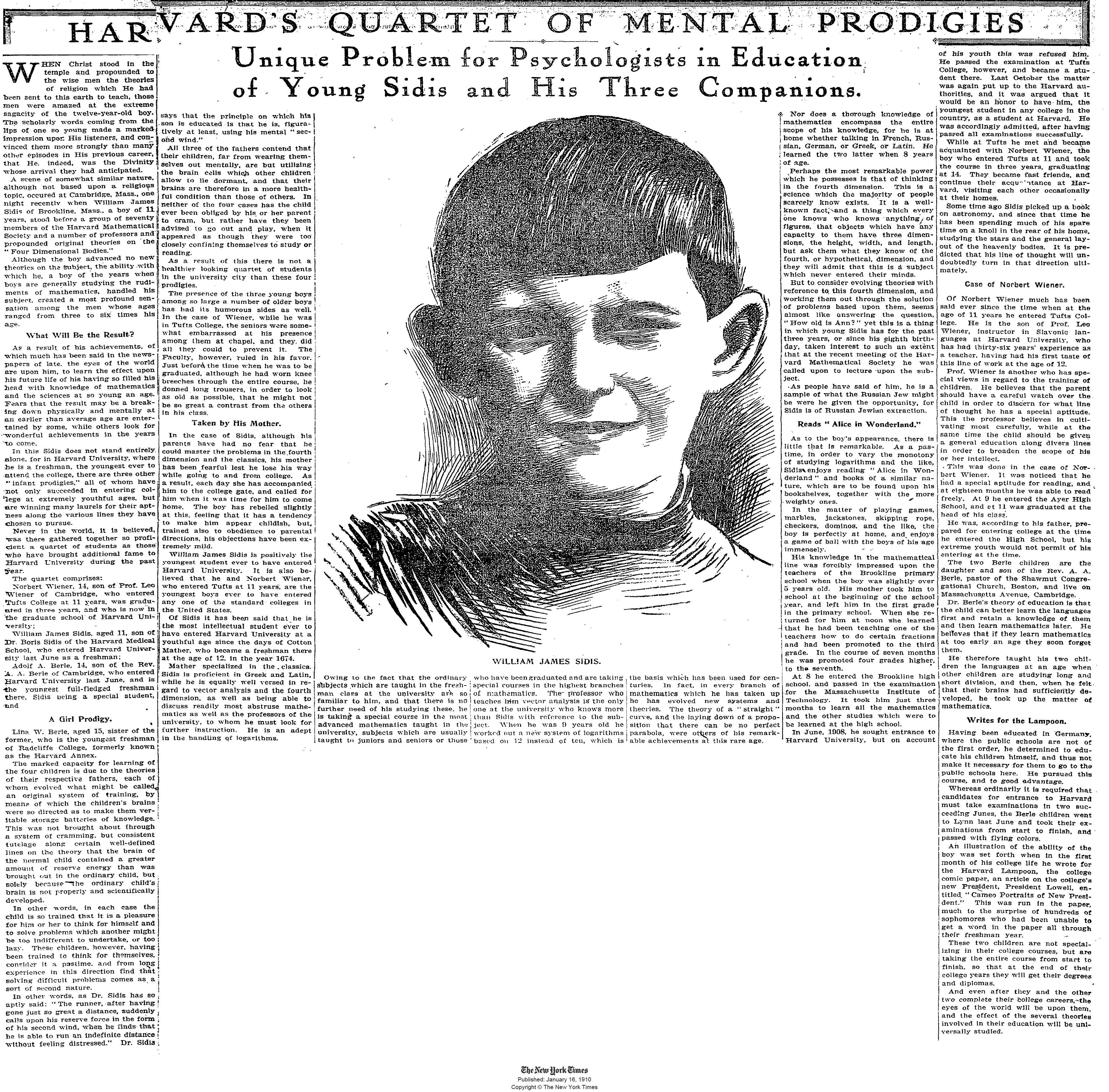
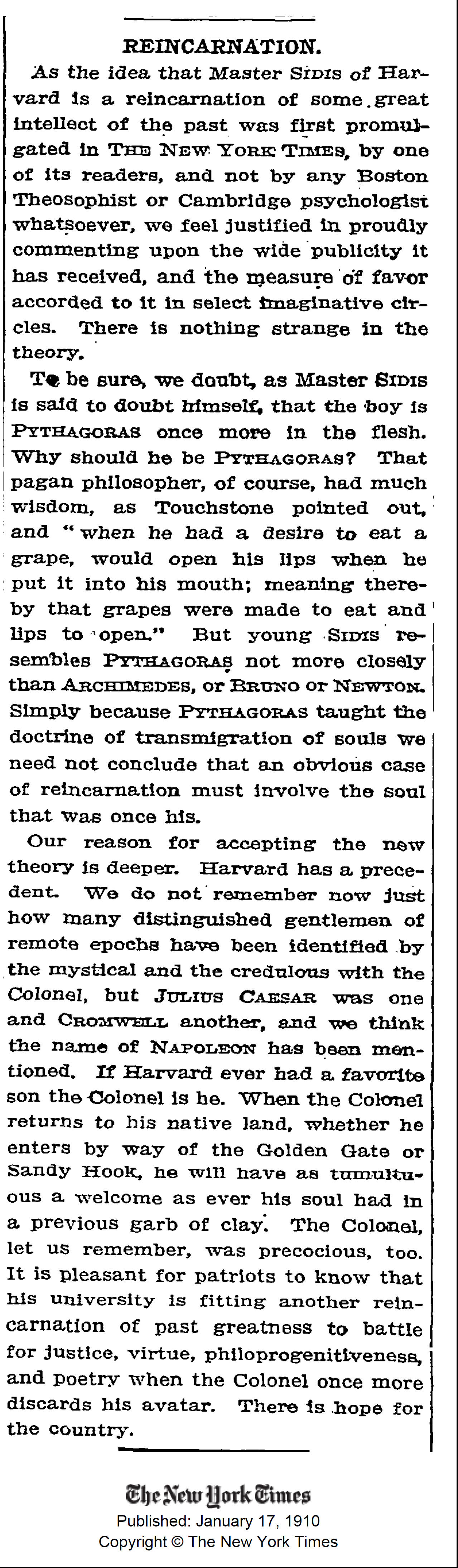

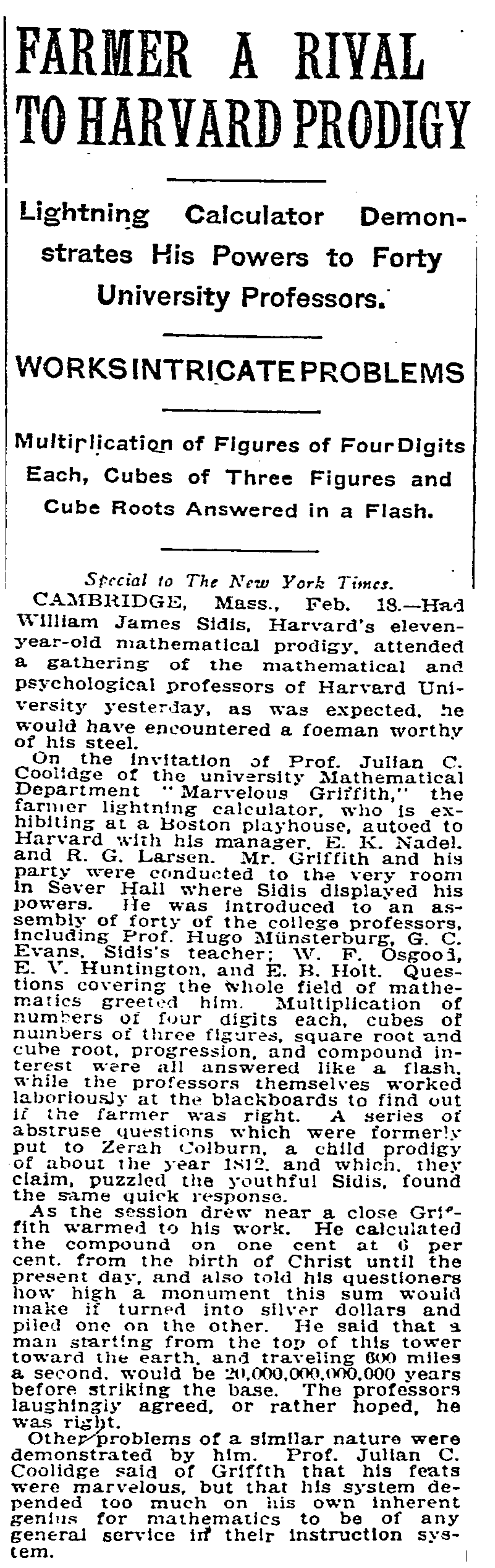

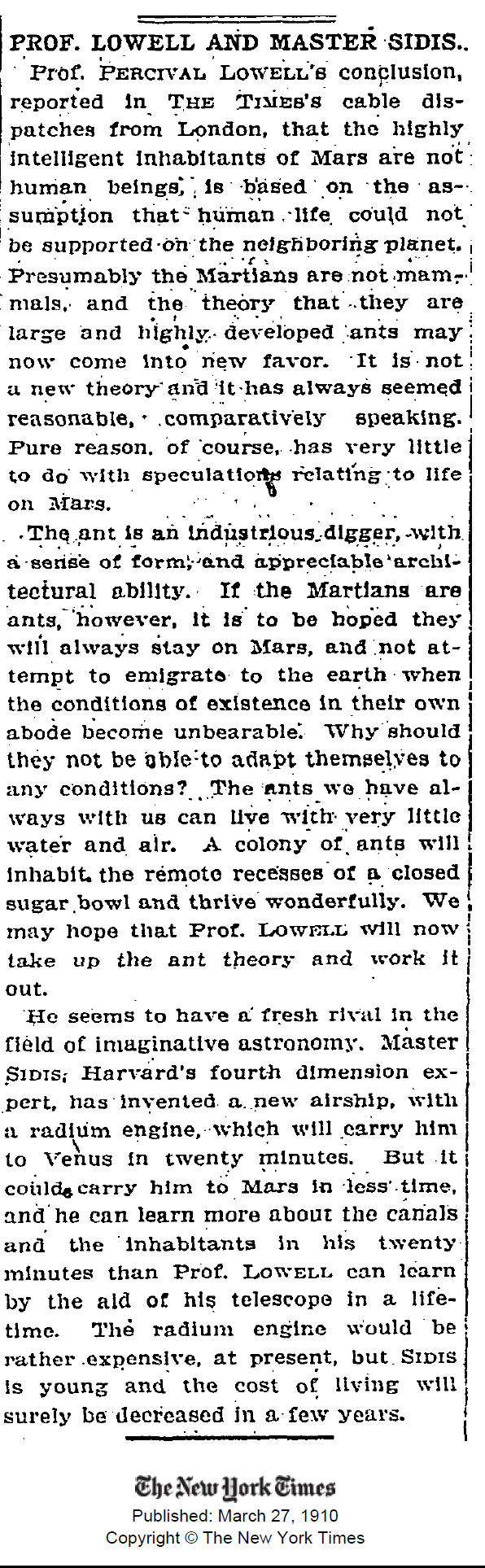
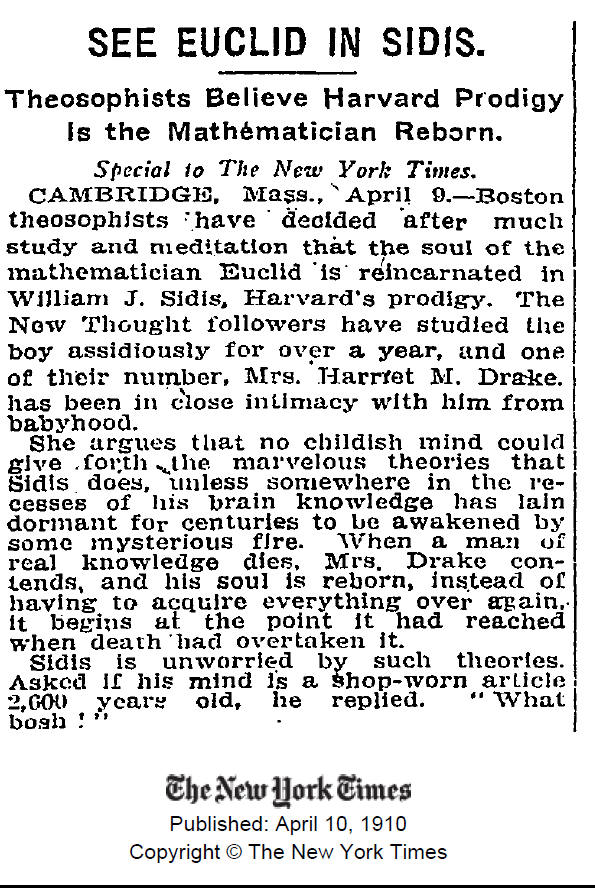
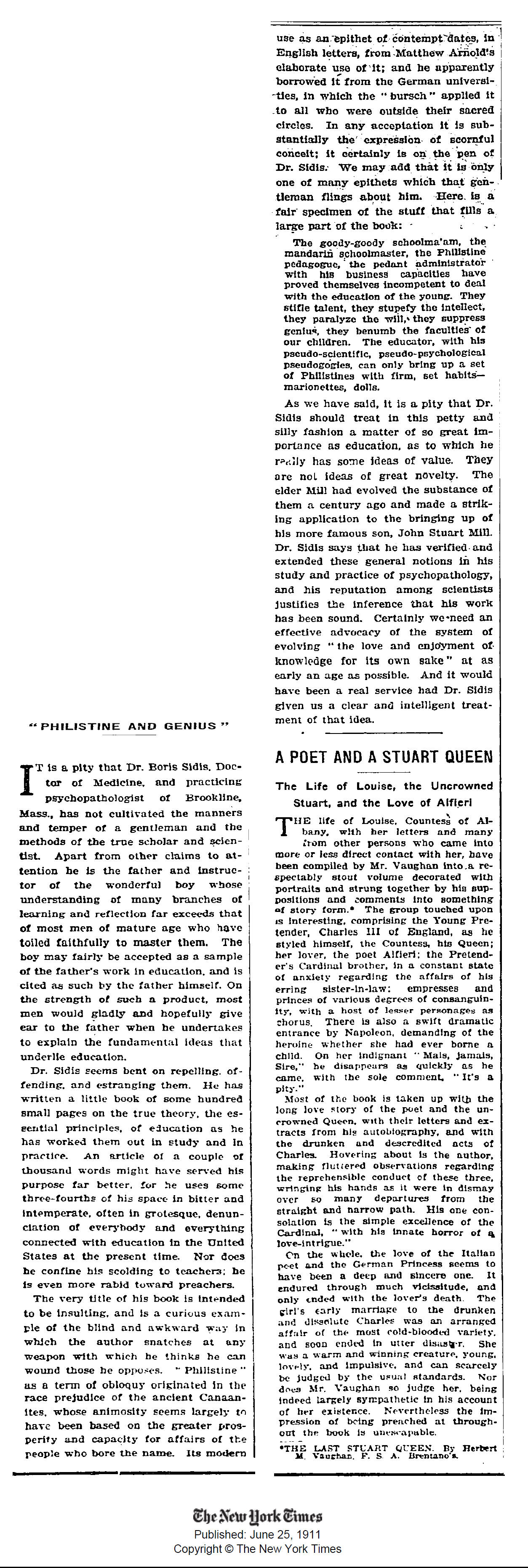


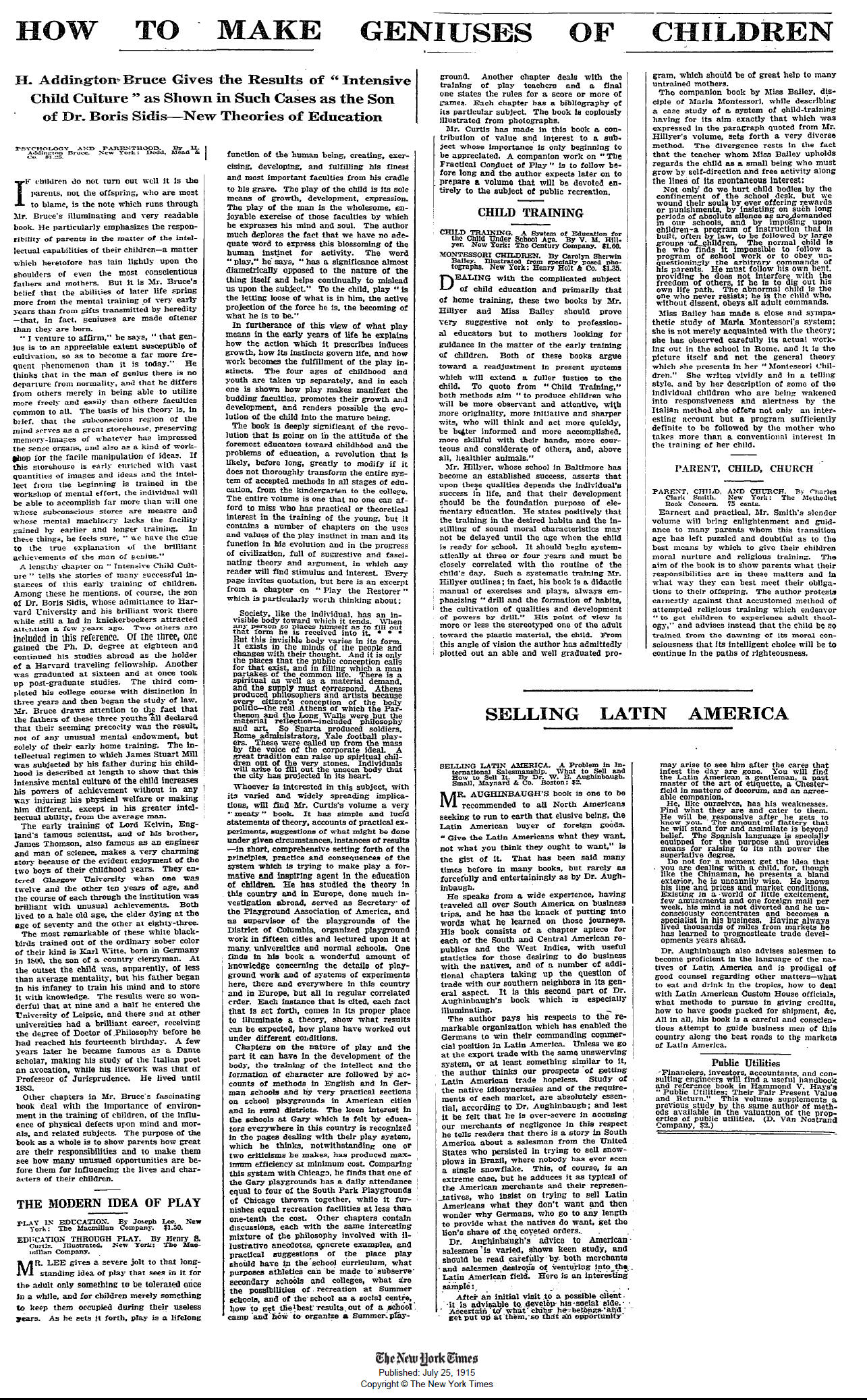

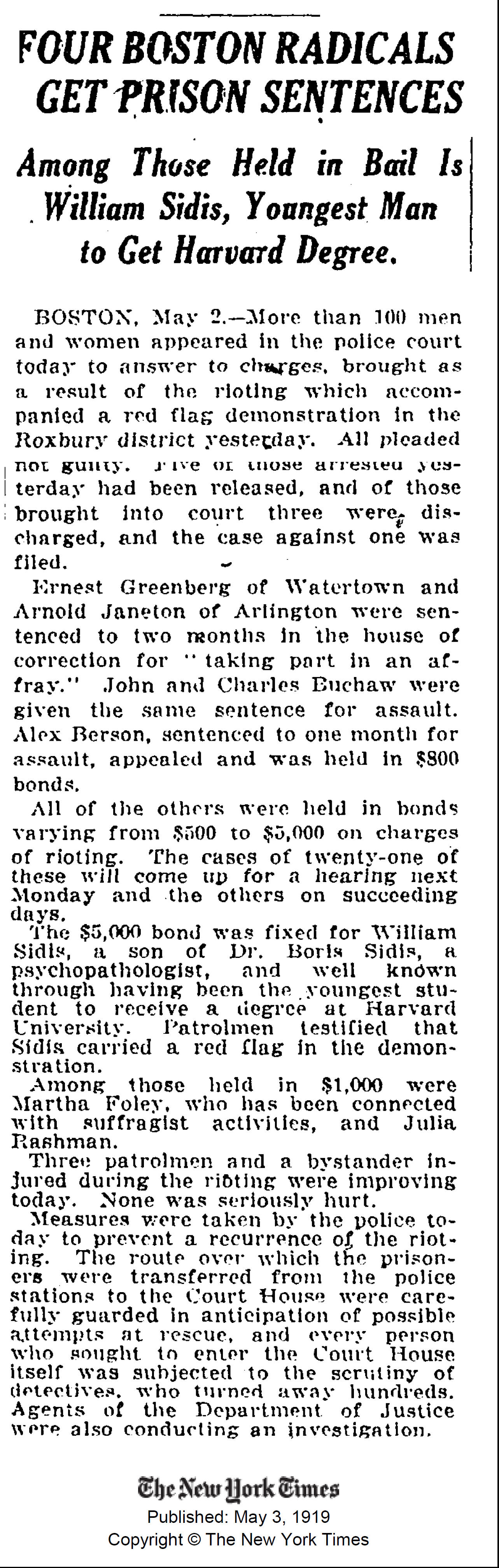
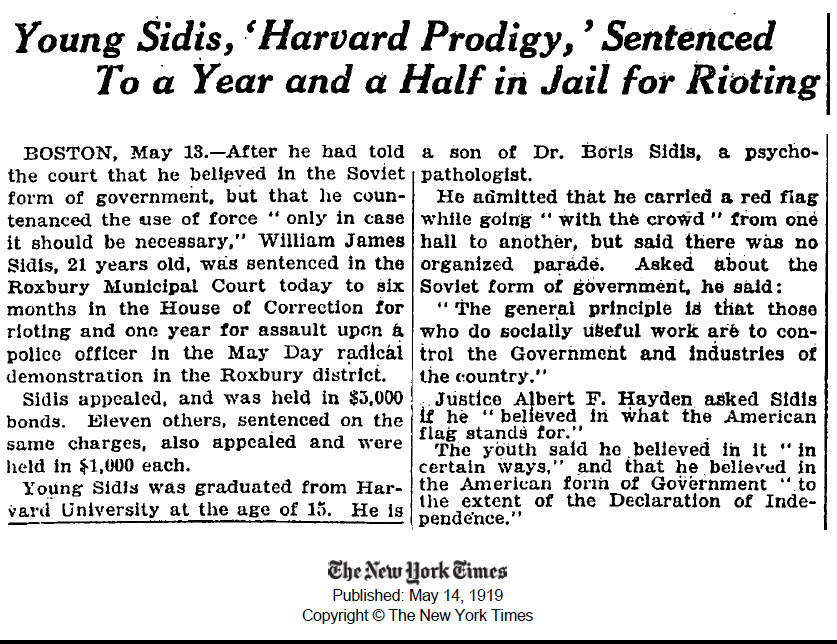


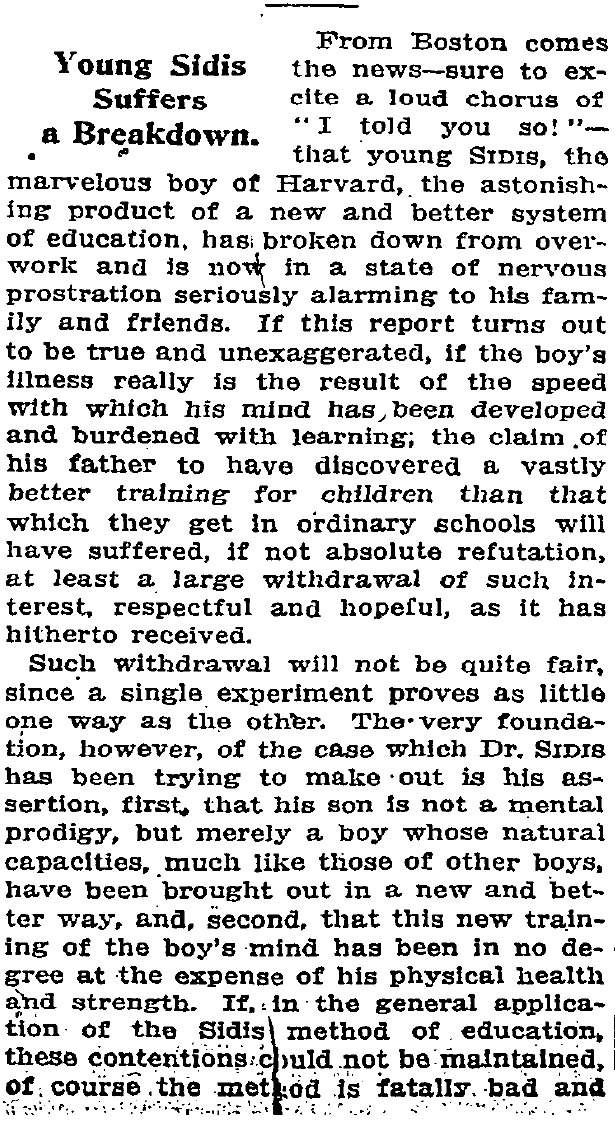


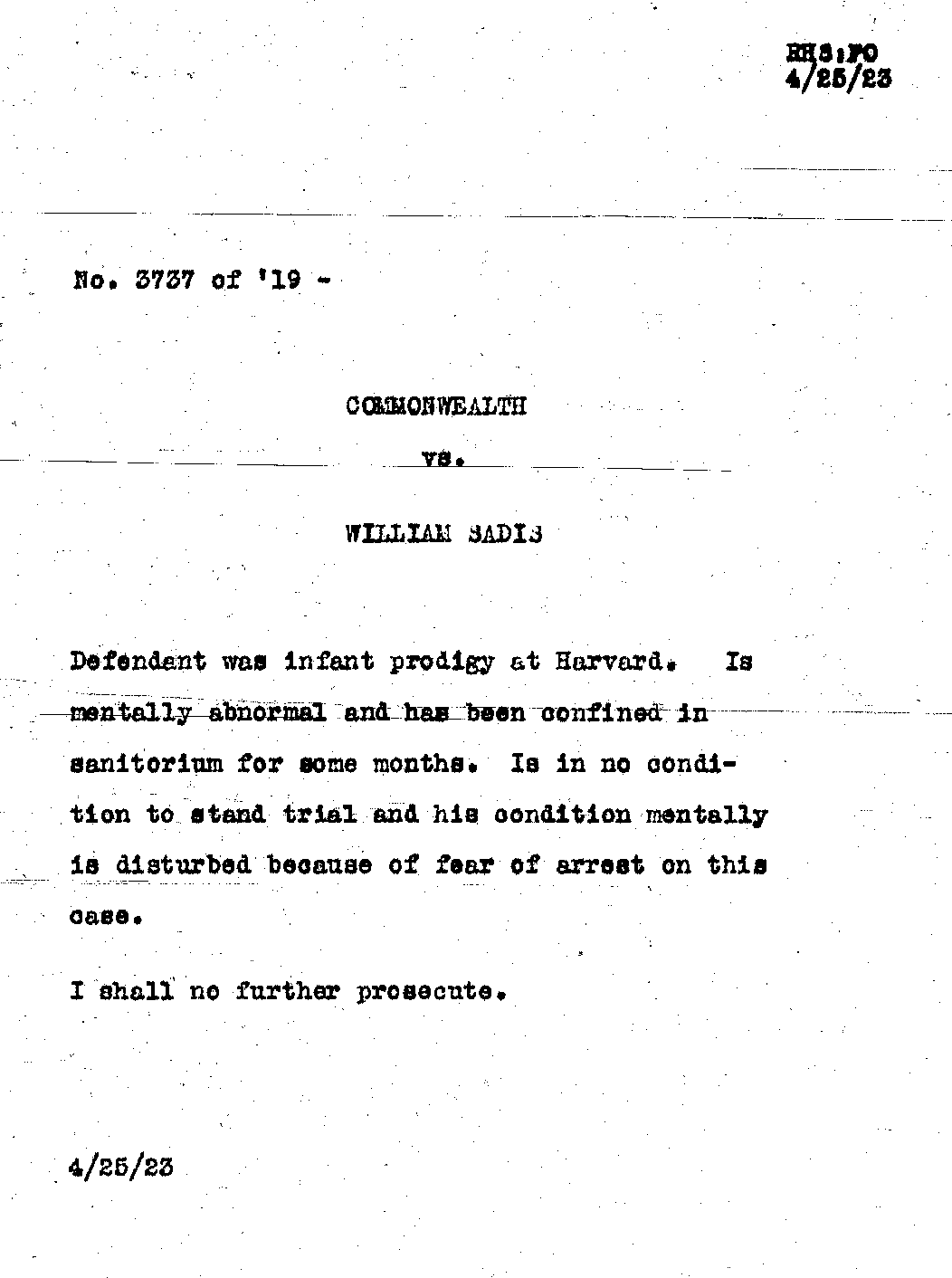
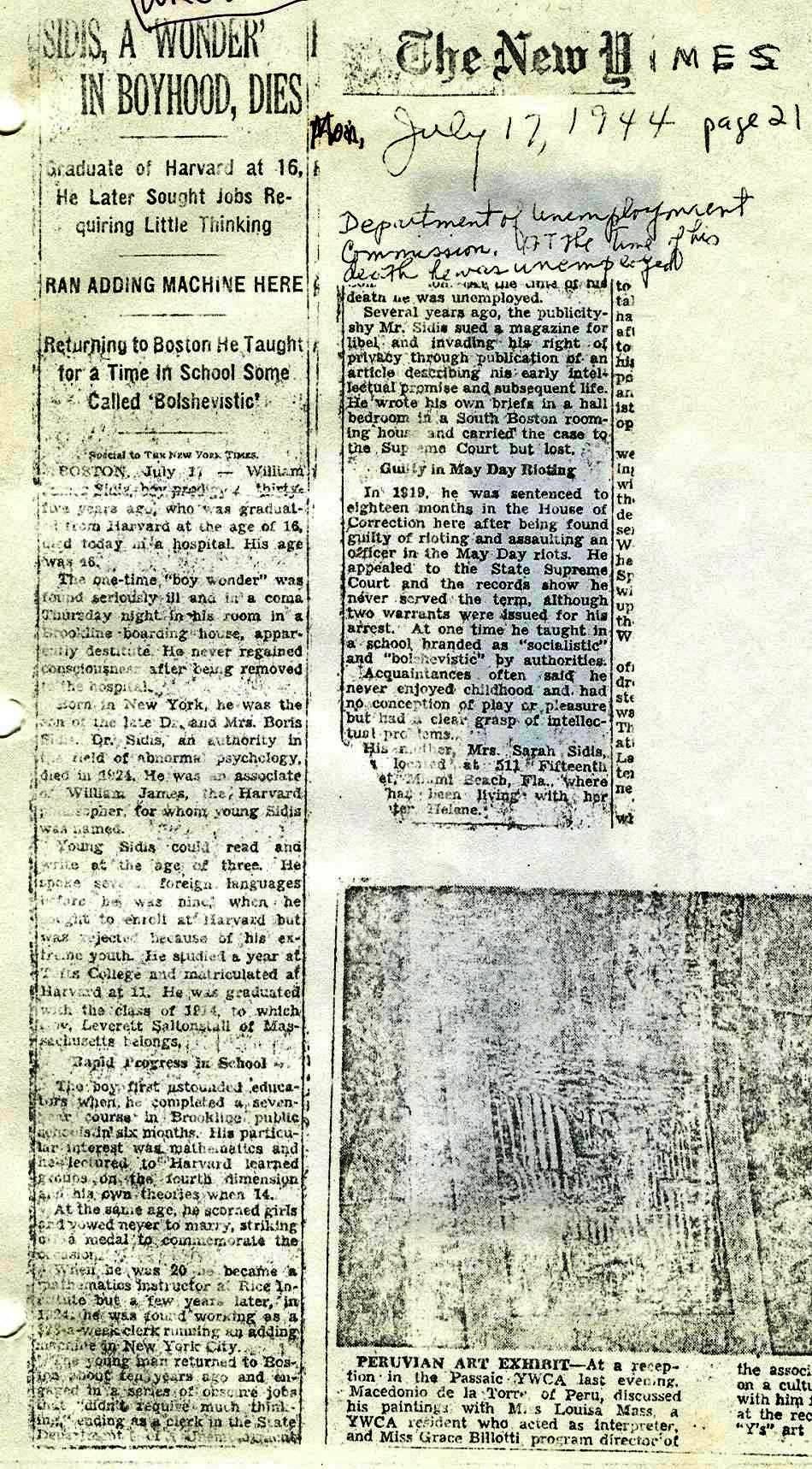




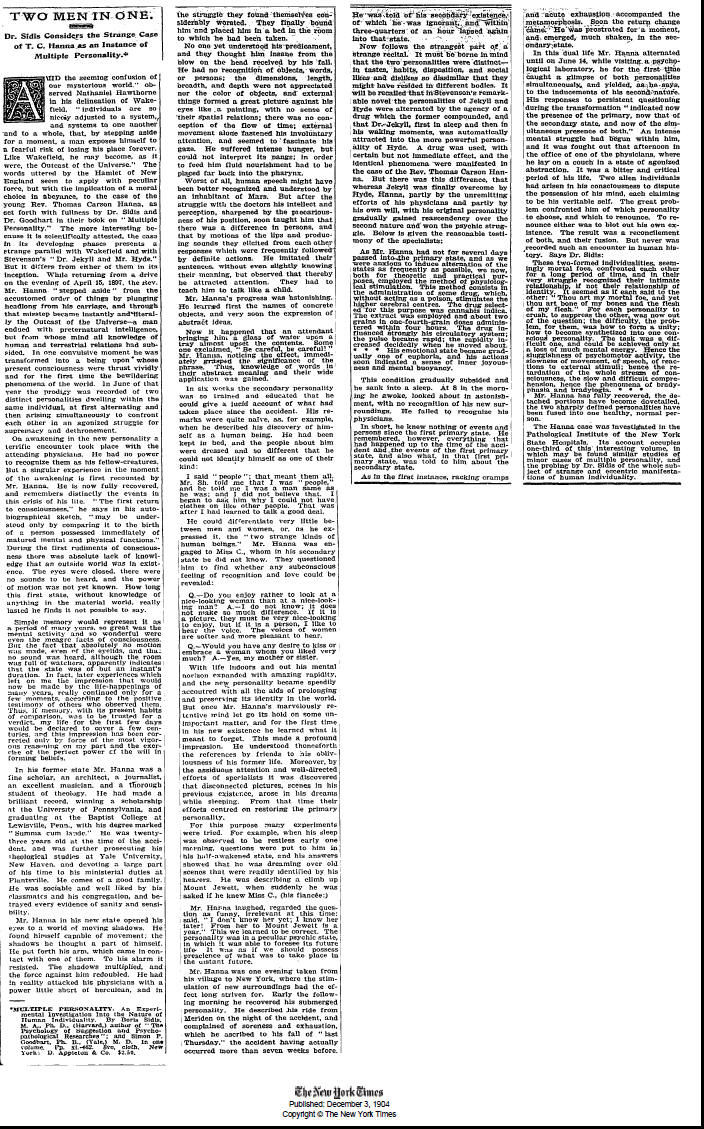
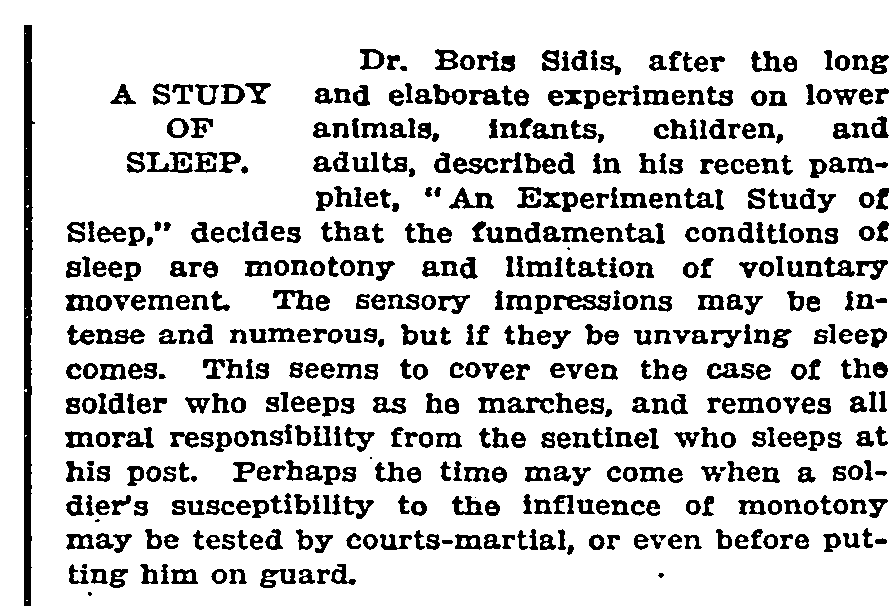

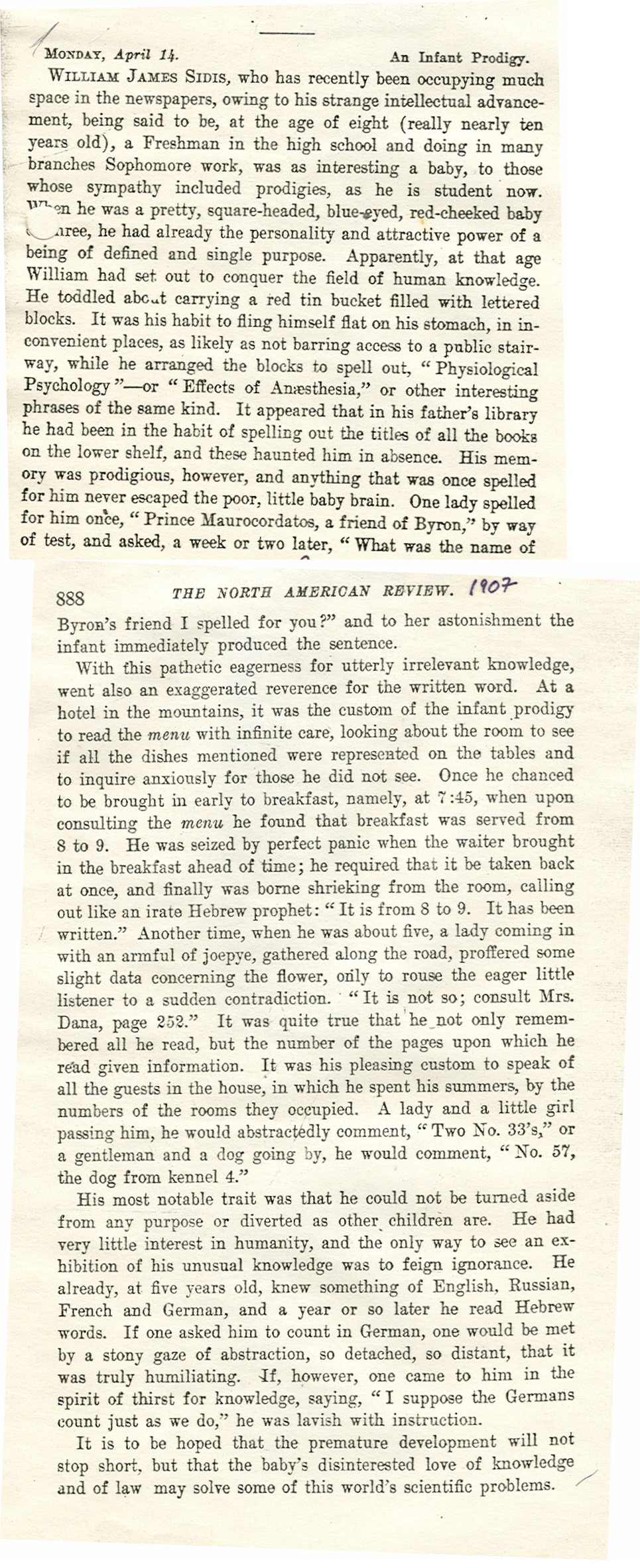

![Brookline [MA] Chronicle, Mar. 7, 1908](brooklinechronicle1908.jpg)